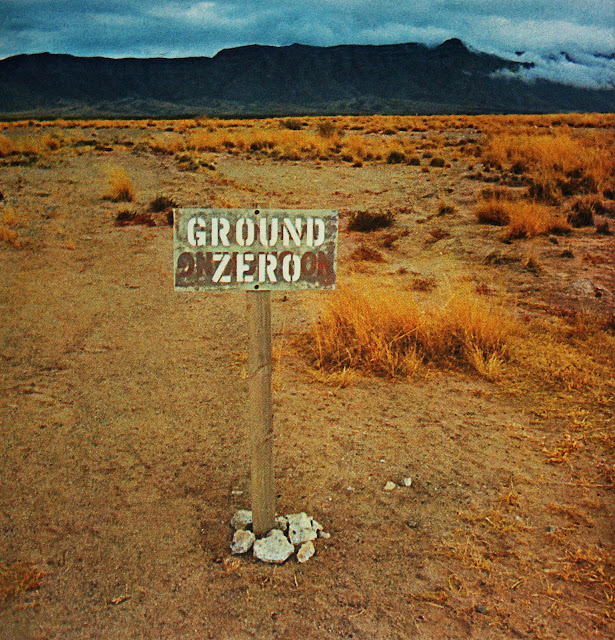
As the 2009 Copenhagen Climate Summit ended in fiasco, Banksy commented wryly by détourning a wall in North London.
Sunday, March 17, 2013
banksy on the meltdown
As the 2009 Copenhagen Climate Summit ended in fiasco, Banksy commented wryly by détourning a wall in North London.
Monday, January 28, 2013
arts of sustainability
![]() |
| Jenny Brown, Learning the Ropes, 2007 |
Forms of Responsibility - Recent Projects by Jenny Brown
by Gary Sangster
In early 2005, an elegant gesture of product repatriation was conceived
and produced by Jenny Brown as a way of both describing certain elements
of a working global economy and tracing the efficiency of a path of
distribution. It was a modest act of economic anthropology that engaged
research, performance, and documentation, as well as articulating an
imagined or real cultural narrative of a concept of homeland and the
actual journey of anonymous artifacts to their site of origin. The
somewhat poignant, yet deeply ironic, pursuit of a homecoming, for near
valueless materials or objects, small stones, garden decor-purchased
inexpensively from a down-market, transnational department store in
Sydney-heightens the sense of disconnection and inauthenticity produced
through a global economic marketplace. The project, Placing stones as they are found,
suggests a sense of loss, or alienation, as objects of value, objects
of use, objects of function, and objects of desire, large or small,
voluble or mute, are interminably transferable, anonymously
interchangeable, dislocated and redefined throughout the trade routes of
mass-market capital. The work is an action of little consequence, a
specific kind of elusive gesture of futility towards irreversible
systems and processes, which makes sense only as a poetic or aesthetic
form of art.
Labels:
biosphere,
gary sangster,
jenny brown,
permaculture
Monday, December 24, 2012
dispatch from spain
[Last
autumn, a new and awful form of protest came to Spain. A string of homeowners
on the verge of eviction by court orders and the riot police (antidisturbios) committed
suicide by leaping from the windows of their mortgaged houses. The growing
anti-eviction movement has altered the dynamic of social protest in Spain,
broadening and deepening the opposition to austerity already manifested in the
15M and 25S movements. In the general strike of 14 November, called for by the
largest unions, ‘everyone except the Partido Popular and Basque nationalist
unions’ poured into the streets. Darío Corbeira, editor of Brumaria, sends the following
reflection on the context of the unfolding social struggle. Many thanks to him
for taking the time, and to Maria Adelaida Samper for the fine translation. –GR]
Hermeneutic
Antidisturbios:
25S, the Anti-Eviction Movement and the 14 November General Strike in Context
By Darío
Corbeira
On 25
September, several thousand citizens responded to an anonymous call to surround
Madrid’s Congress of Deputies: ‘Surround the Congress, remain there
indefinitely. Desert and break with the current regime, demand the dissolution
of the entire government, courts and heads of state, and abolition of the
existing Constitution. Begin constituting a new system of political, economic
and social organization.’
The gathering citizens aimed to convey to the parliamentarians their deep
opposition to the austerity program of Mariano Rajoy Brey’s governing Partido
Popular (PP) and to the interventions of the European Central Bank,
International Monetary Fund and European Union. Framing it was a radical
critique of the parliamentarism that came out of the so so-called Transition to
democracy. As made clear in their manifestos, proclamations and chants, the
protesters saw that form of democracy as utterly bankrupt. What began that day
has become known as the 25S movement, distinct from but clearly related to its
predecessor 15M and the other movements that have emerged from the
neighbourhoods, universities, hospitals, cultural centers, and manufacturing
areas. All were questioning the perverse effects of neoliberal policies
designed by financial capitalism and applied to the letter by the governing
authorities. Those effects have shaken the fragile ‘welfare state’ slowly built
up since Franco’s death and have undermined all it has achieved by way of
diminishing the gaping social and economic disparities that persist in Spain
despite the governments of the Partido Socialista Obrero Español (Spanish Socialist Worker’s
Party/PSOE).
Labels:
austerity,
brumaria,
darío corbeira,
struggles
Thursday, December 13, 2012
re third text
There is no more point in mincing words: the journal Third Text has been hijacked by its own Board of Trustees. The fiats of this administrative regime have, over the last two years, shut out founder Rasheed Araeen and turned over editorial control to a usurper whose abilities inspire little confidence and whose politics are dubious. This, in the name of bureaucratic values: "professionalization" and neo-liberal "governance." In the background, publisher Taylor & Francis and funding agency Arts Council England may have welcomed such changes, but for all those who know the history of this journal and value its committed critical vision, this takeover is unacceptable.
![]() |
| Rasheed Araeen at Asia Art Archive, 2009 |
In the 1970s, artist Rasheed Araeen emerged as a leader in the struggle against institutionalized racism in the London art world. Positions first expressed in his 1975/6 "Preliminary Notes for a BLACK MANIFESTO," were developed in the late 1970s into the anti-imperialist Black Phoenix, and eventually, in 1987, into Third Text. Through the 1990s and into the new century, this journal nurtured many new voices, including my own, and was truly a forum for global critical perspectives on contemporary art and culture. Its feisty spirit was fed by its origins in struggle, and practical amnesia from above will not make this history disappear.
Wednesday, November 14, 2012
review: lilley et al on catastrophism
Review: Sasha
Lilley, David McNally, Eddie Yuen and James Davis, Catastrophism: The
Apocalyptic Politics of Collapse and Rebirth (PM Press, 2012)
This is the end. My
only friend: the end. - JM
Capitalist
governance is hardly thinkable today outside the shifting contours of the
politics of fear. Terror pulses and surges within the global social process,
and anxiety shapes the very forms of contemporary subjectivity. The logic of
accumulation dominates through a flexible mix of enjoyment and enforcement. Under
the pressures and miseries of social and ecological crises, fantasies of doom
animate both the dream machines of the culture industry and the political
imaginaries of divergent social movements. To experience collective
self-destruction as a supreme aesthetic pleasure, Benjamin noted back at the
opening of the new era of terror, is bad politics.
Catastrophism:
The Apocalyptic Politics of Collapse and Rebirth offers a superb and needed critical overview
of current tendencies toward an aestheticizing politics of doom. Evolving out
of discussions catalyzed by Iain Boal and the Retort collective, these essays
by Lilley, McNally, Yuen and Davis survey and analyze the traps and delusions
involved when catastrophe scenarios are deployed as a mobilizing political
figure. Clearly, we need to understand these pitfalls, for as Yuen observes,
our moment ‘is saturated with instrumental, spurious, and sometimes maniacal
versions of catastrophism – including right-wing racial paranoia, religious
millenarianism, liberal panics over fascism, leftist fetishization of
capitalist collapse, capitalist invocation of the “shock doctrine,” and pop
culture cliché’(pp. 15-16).
Labels:
biosphere,
eddie yuen,
gene ray,
permaculture,
reviews,
struggles
Friday, November 2, 2012
science in the force field
Climate scientists have not yet reached consensus about whether global warming will tend to increase or decrease the total number of hurricane-strength storms. But there is strong agreement that warming creates the conditions for larger and more powerful hurricanes: warmer sea surface temperatures, higher sea levels and more moisture in the atmosphere. These general tendencies interact with other local and regional factors to produce the local weather.
Climatologist Kevin
Trenberth parses the specific conjuncture that intensified Hurricane Sandy:
‘The sea surface temperatures along the Atlantic coast have been running at
over 3C above normal for a region extending 800km off shore all the way from
Florida to Canada. Global warming contributes 0.6C to this. With every degree
Celsius [of warming], the water holding of the atmosphere goes up 7%, and the
moisture provides fuel for the tropical storm, increases its intensity, and
magnifies the rainfall by double that amount compared with normal conditions.’
In the week or so
before Hurricane Sandy pummeled the northeast US, the warming denial industry
was hard at work. The right-wing, Koch-funded Cato Institute (publishers of In
Defense of Global Capitalism,
among other dismal screeds) attempted to sabotage a US government assessment of
climate change impacts by issuing what poses as an ‘addendum’ to the original.
The 2009 report, Global Climate Change Impacts in the United States, was
prepared by the US Global Change Research Center and presented to Congress as a
summary of the ‘best science’ on the subject. The authoring federal entity is
itself a conglomeration of thirteen departments and agencies, including the
National Science Foundation, NASA and the Smithsonian Institution, but also others, like the Environmental
Protection Agency, that are routinely contained by hostile political
appointments, as well as a battery of agencies straightforwardly in the
business of promoting or defending the status quo of accumulation (Departments
of Commerce, Interior, Energy, Defense and State, and the Agency for International
Development). One can only imagine the pressures and internal struggles that
shaped the publication of this report.
Monday, October 29, 2012
administering biodiversity
‘Extinction rates are rising by a factor of up to 1,000 above natural rates. Every hour, three species disappear. Every day, up to 150 species are lost. Every year, between 18,000 and 55,000 species become extinct. The cause: human activities.’
- Ahmed Djoghlaf,
head of the UN Convention on Biological Diversity.
The problem, again:
The interconnected ecosystems that make up the biosphere are all dependent on
the capture, conversion and distribution of the sun’s energy through the
planetary cycling of carbon. The biosphere has proved to be fairly resilient.
Within the constraining parameters of life on earth, however, changes in
climate can have enormous consequences. Interventions, human or non-human, that
impact ecosystems and the carbon cycle can result in irreversible losses of
biodiversity and trigger abrupt and uncontrollable climate changes. The
contemporary form of human society – the global social process we know as
capitalist modernity – has initiated both a new mass extinction event and
global warming. As a result, tens of thousands of life forms will be
‘disappeared’ and millions of people will lose, directly or indirectly, their
lives, health or homes through famine, drought, illness and war. These
processes are already unfolding. The urgent question is: how far will they go?
Put differently, the
problem is the dominant social process and the difficulty in changing it. The
social process, organized to maximize capital accumulation and channeled
through a rivalrous interstate system, compels all individuals to compete for
places in a national economy and compels all states to promote and defend one
national economy against all others. Growth, measured in Gross Domestic
Product, is a given. By this logic, capital and biosphere are caught in a relation
of antagonism, setting up endless and dreary struggles between the claims of
jobs and environment, profits and endangered species, consumption and
biodiversity. Through this optic, climate change and mass extinction are simply
matters of national security and risk assessment. It is taken for granted that
science and technology will enable human adaptation to ecological degradation
and the weather. The national security-surveillance state is oriented toward
enforcing the current social logic, not changing it. The state’s concern is:
who can dominate in the new climate scenario? Or in other words: what must be
changed, in order to keep in place the current regime of accumulation and logic
of domination? Seen from below, however, the problem is how to change that very
logic.
Wednesday, October 24, 2012
greening documenta?
![]() |
| Kristina Buch, The Lover, 2012 |
Radical Camouflage at Documenta 13
by Julian Stallabrass
Documenta, held every five years in the central German city of Kassel, is the art world’s equivalent of the Olympics. While its scale may be rivalled by Venice, its five-yearly timetable and large budget allow curators time to develop an elaborate vision, and it has often been used to test the temperature of contemporary art production. Some previous editions have been very influential in changing the direction of the art world—for instance, Catherine David’s Documenta X and Okwui Owenzor’s Documenta XII did much to push it towards documentary and a greater engagement with politics.
The unusual situation and history of Documenta has haunted many of its editions, including the one currently on show. Kassel is a smallish industrial city set in hilly and forested countryside. In the Second World War, it produced planes and tanks, and it is still a production centre for Germany’s main battle tank, a fact that has not escaped Kassel’s Occupy protestors. The city was repeatedly bombed by the RAF, and extensively destroyed, with thousands killed and many more made homeless. As with so many German cities, its modern centre is the product of that destruction, and its few older buildings were those considered worth restoring from ruin. Documenta, founded in 1955, was from the beginning seen as a restoration of Nazi cultural wrecking, and its first edition showed works of classical modernism which had, of course, been condemned by the Nazis as ‘degenerate’. They were shown in what remains the main venue of Documenta, the Fridericianum, which then still bore some of the marks of war damage.
The current Documenta—or dOCUMENTA (13) if you follow the rubric of its branding—is a vastly ambitious attempt to influence the course of art and culture as a whole. Its curator, Carolyn Christov-Bakargiev, using a frame of reference that takes in phenomenology, quantum theory, feminist thinking and psychoanalysis, wants to push the centre of human cultural concerns away from simple subject-object oppositions towards a perspective that would take in the viewpoints of all entities, living and inorganic. If matter has an intricate connection with information, at least at the quantum level, then all entities may be said to communicate and even to have will. In recounting a failed attempt to have the world’s heaviest meteorite shipped across the world for display at Documenta, Christov-Bakargiev is led to ask, not just what she wanted or what the rock’s custodians (the indigenous Moqoit people in Argentina) wanted, but what it wanted:
'It had traveled through vertiginous space before landing on Earth and settling. Would it have wished to go on this further journey? Does it have any rights, and if so, how can they be exercised? Can it ask to be buried again, as some of the Moqoit argue, or would it have enjoyed a short trip to an art exhibition, rather than a science or world’s fair?'
This thinking is used to prop up a series of gestures towards radical positions: environmental, activist, participatory, anti-war, and in the defence of various minorities. In all this, it is paramount that there must be no ‘closure’, no settling and no agreement: rather a dissonant dance of beings and objects in which all perspectives are acknowledged in an ‘anti-logocentric’ frame.
by Julian Stallabrass
Documenta, held every five years in the central German city of Kassel, is the art world’s equivalent of the Olympics. While its scale may be rivalled by Venice, its five-yearly timetable and large budget allow curators time to develop an elaborate vision, and it has often been used to test the temperature of contemporary art production. Some previous editions have been very influential in changing the direction of the art world—for instance, Catherine David’s Documenta X and Okwui Owenzor’s Documenta XII did much to push it towards documentary and a greater engagement with politics.
The unusual situation and history of Documenta has haunted many of its editions, including the one currently on show. Kassel is a smallish industrial city set in hilly and forested countryside. In the Second World War, it produced planes and tanks, and it is still a production centre for Germany’s main battle tank, a fact that has not escaped Kassel’s Occupy protestors. The city was repeatedly bombed by the RAF, and extensively destroyed, with thousands killed and many more made homeless. As with so many German cities, its modern centre is the product of that destruction, and its few older buildings were those considered worth restoring from ruin. Documenta, founded in 1955, was from the beginning seen as a restoration of Nazi cultural wrecking, and its first edition showed works of classical modernism which had, of course, been condemned by the Nazis as ‘degenerate’. They were shown in what remains the main venue of Documenta, the Fridericianum, which then still bore some of the marks of war damage.
The current Documenta—or dOCUMENTA (13) if you follow the rubric of its branding—is a vastly ambitious attempt to influence the course of art and culture as a whole. Its curator, Carolyn Christov-Bakargiev, using a frame of reference that takes in phenomenology, quantum theory, feminist thinking and psychoanalysis, wants to push the centre of human cultural concerns away from simple subject-object oppositions towards a perspective that would take in the viewpoints of all entities, living and inorganic. If matter has an intricate connection with information, at least at the quantum level, then all entities may be said to communicate and even to have will. In recounting a failed attempt to have the world’s heaviest meteorite shipped across the world for display at Documenta, Christov-Bakargiev is led to ask, not just what she wanted or what the rock’s custodians (the indigenous Moqoit people in Argentina) wanted, but what it wanted:
'It had traveled through vertiginous space before landing on Earth and settling. Would it have wished to go on this further journey? Does it have any rights, and if so, how can they be exercised? Can it ask to be buried again, as some of the Moqoit argue, or would it have enjoyed a short trip to an art exhibition, rather than a science or world’s fair?'
This thinking is used to prop up a series of gestures towards radical positions: environmental, activist, participatory, anti-war, and in the defence of various minorities. In all this, it is paramount that there must be no ‘closure’, no settling and no agreement: rather a dissonant dance of beings and objects in which all perspectives are acknowledged in an ‘anti-logocentric’ frame.
Labels:
biosphere,
enjoyment,
julian stallabrass,
reviews
Sunday, October 14, 2012
reflexive domination and plastic soup
![]() |
| Photo: Mandy Barker |
Görg thinks the human
relation to the biosphere is changing in some subtle ways, and he calls for a
nuanced analysis of the domination of nature. As the ecological crises become
increasingly undeniable, he argues, elites are responding in ways that cannot
be characterized as simple denial or disavowal. In the post-Fordist phase of
capitalist accumulation, the historical attempt to achieve utter or complete
mastery of nature is finally understood to be impossible, according to Görg.
Instead, technocrats and CEOs now try to master the unintended negative
consequences of the failing forms of the attempted mastery of nature. But this
‘mastery of secondary effects’ or ‘reflexive domination of nature’ is a
strategy of risk management that does not give up the goal of capital
accumulation. The master logic remains the same, but the degrading biosphere is
now addressed as an assessable risk or ‘security problem’ that must be coped in
order to sustain the expectation of high returns on investment.
![]() |
| Photo: Mandy Barker |
Wednesday, October 10, 2012
on the mattering of silence and avowal
'
![]() |
| Arman, untitled combustion, 1964 |
Plight of the After: Further Notes on Cage,
Silence, Arman, Beuys, Adorno, Beckett, Trauma, Rememoration and Negative
Presentation in Post-1945 Visual Art
by Gene Ray
![]() |
| Beuys, Plight, 1985 |
Two works by Joseph Beuys,
or more precisely, two contrasting moments in his output: the first, a proposal
for a Holocaust memorial produced in 1958, a feeble misfire; the second, the
installation Plight, made and
exhibited in 1985, a forcefully effective work of historical avowal. These two
moments document the impressive development of one German artist. But more than
that, they indicate the whole painful struggle within the visual arts to
confront and respond to the Nazi genocide, a crime of state terror for which
the place-name ‘Auschwitz’ has come synecdochically to stand. For visual
artists willing to risk such a confrontation, the means and strategies with
which to do so were by no means clear or obvious in 1958; if, after 1985, such
means and strategies were established and available, that was due to the work
of many, in a collective development that was absorbed and synthesized in Plight.
Beuys’ proposal for a
memorial at Auschwitz-Birkenau, submitted in March 1958 to the juried
competition organized by an association of camp survivors, was a failure by any
standard. His offer to overshadow the camp with a monumental ‘monstrance’ derived
from Roman Catholic ritual was wildly, monstrously inappropriate. I register
this moment of misfire only to establish Beuys’ relatively early concern with
the meaning, legacy and representation of Auschwitz. Beuys was one of 426
artists who submitted proposals to the jury convened in 1956 by the Comité
international d’Auschwitz. For it, he produced numerous drawings and models in
wood, pewter and zinc. None are compelling or evince much insight. Some were
later incorporated into various installations and vitrines, including Auschwitz
Demonstration 1956-1964; the dates
in the title of the latter indicate the artist’s retrospective desire to
establish his continuous engagement with the Nazi genocide and the problem of
its artistic representation. This desire is significant, especially given
Beuys’ evident reticence with regard to Nazism and its crimes. These early
sketches and models, loaded with the Christian symbolism of sin, guilt,
sacrifice and forgiveness, may betray the stirrings of the artist’s own
unresolved conflicts in facing this history. They certainly illuminate a
profound confusion before the crisis of representation imposed on art ‘after
Auschwitz’, to use the phrase of Theodor W. Adorno. This confusion was hardly
unique at the time; it marks a moment when the dialectic between genocidal
history and representation was felt by some European visual artists as the
pressure of a still unclarified problematic.
![]() |
| Beuys, Auschwitz Demonstration, 1964 |
The negative presentation
of Auschwitz through the indirect material linkages and evocative strategies
deployed so effectively in Plight
– the environment he installed in the London gallery of Anthony d’Offay in 1985
– was only possible after the investigation of negative presentation in the
visual arts had reached a certain point of development. The artistic strategy
evident in this work manifests an understanding of the potentials of negative
evocation to respond to historical trauma and catastrophe, as well as an at
least minimally conscious control of the sculptural means for such evocation.
With regard to artistic means, all the techniques used by Beuys in Plight had probably been developed by other artists by
the end of 1961, although their potentials would not have been immediately
clear to all.[1] The necessary historical disclosures no doubt took longer to
circulate and fully sink in; the critical processing of those disclosures is by
no means complete today.
Plight is a culminating work, in the precise sense that
it consolidates this collective investigation and development that took place
in the visual arts between 1945 and the end of 1961 in a way so compelling that
it establishes a new standard for artistic approaches to Auschwitz. The
negative memorials that in the 1990s would become the institutionally preferred
model for monumental public remembrance are prefigured by Plight and are, by and large, merely echoes or variations
on it. I am not concerned in this essay to treat Beuys’ personal development or
career in any detail, beyond what I have done elsewhere.[2] Here I focus on Plight, in order to unfold from this one work the
outlines of a larger history – the discovery and development, in the visual
arts, of negative, dissonant strategies for representing catastrophic history
in the aftermath of World War II.
Friday, October 5, 2012
review: wilson on the mass extinction
Review: Edward O.
Wilson, The Future of Life
(Little, Brown, 2002)
‘Although it is possible
to predict species extinction for the near future – say, over the next decade
or two – such a projection is impossible for the more distant future. The
obvious reason is that the trajectory depends on human choice. If the
decision were taken today to freeze all conservation efforts at their current
level while allowing the same rates of deforestation and other forms of
environmental destruction to continue, it is safe to say that at least a fifth
of the species of plants and animals would be gone or committed to early
extinction by 2030, and half by the end of the century. If, on the other hand, an all-out effort is made
to save the biologically richest parts of the natural world, the amount of
loss can be cut by at least half.’
– Edward O. Wilson, The Future of Life (pp. 101-2)
This is, I am obliged to
say right away, my first reading of a book by Edward O. Wilson. I can’t say it
is my first encounter, for I have met this name many times already. Wilson is
one of those prolific scientists whose presence and influence has grown far
beyond his area of specialization (myrmecology, the study of ants) and has
attained enough aura and eminence, within the mediations of spectacular
culture, to enable him to act as that rarity, a public intellectual: someone
whose views and assessments are widely disseminated and may actually count for
something in the deliberations of policymakers and even, perhaps, in the
formation of so-called public opinion.
I read this book to learn
more about the loss of biodiversity and the extinction of species. In
particular, I wanted to know what is behind Wilson’s assertion, often cited in
the literature around extinction, that if nothing is done to counteract current
trends, we can expect to lose half of all present life-forms by the end of the
twenty-first century. This book certainly clarifies his position and provides
all the evidence and steps that led him to this shocking prognosis. The gyst is
in the citation above, and I discuss Wilson’s prescriptions for the
conservation of global biodiversity at the end of this review.
Friday, September 28, 2012
review: nicholsen on the bio-meltdown
Shierry Weber
Nicholsen, The Love of Nature and the End of the World: The Unspoken
Dimensions of Environmental Concern
(MIT Press, 2002)
Those concerned and
alarmed by the biospheric meltdown need to understand the obstacles that are
blocking effective responses. These obstacles are mainly of two kinds: social
and psychological. The unsustainable logic of accumulation that drives our
contemporary capitalist society is also driving the biospheric crisis. But to
change this logic would be to change the form of society itself. To do that, we
would have to overcome formidable processes of social reproduction, including
the addictive enjoyments of commodified life and the coercive enforcements of
war machines and state terror.
The psychological
blockages are no less formidable. To respond effectively to catastrophic
ecocide, we would first need to bring it fully to awareness and attention. The
extent of the damage being done is staggering and the implications are
intimidating. We would need to acknowledge the destructiveness of our current
way of life and our own deep implication in the global social process. Such
awareness is painful and distressing. The feelings of fear, anxiety and guilt
it may arouse are so threatening, in fact, that they provoke all our psychic
defenses: we avoid this awareness by repressing and disavowing it, or by
projecting it outward in the form of more violence or self-violence.
Sunday, September 23, 2012
elegy for an albatross
A juvenile albatross
desiccate on sand, feathers cupping the fist of flotsam that starved it. As the
biosphere melts down and species disappear forever, Chris Jordan documents the
real appearance-forms of accumulation. On Midway Atoll (Pihemanu Kauihelani in Hawaiian), in the middle of the North Pacific, he photographed the carcasses of albatrosses killed by plastic.
These are hard images, documents of barbarism in Benjamin’s sense: alarms that
call us to awake.
This archive, which Jordan
subtitles Message from the Gyre,
is a lesson in dialectics. In a forensic sense, these images are evidence of a
deadly process: capitalist modernity interacting with and transforming
‘nature’. In the commodity, capital animates and inspirits dead things with
living relations: they are made to move and dance and flow on a global scale.
Here, in these images, we can see in a flash the terrible, indifferent truth of
this social process: accumulation, our master, grows within life like an
incubus. The commodity – or its traces and refuse – acquires its life at the
expense of life, a process that ends in the starvation of living things and the
slow disappearance of life-forms. Modernity has launched a new mass extinction
event, which now, steadily, comes into view.
Friday, September 21, 2012
capital and biosphere
Modernity
and Biospheric Meltdown:
Rethinking
Exits, Austerities and Biopolitics
by Gene
Ray
In
setting out the agenda for this conference, Yannis Stavrakakis calls for a
critical and postcolonial reflection on the Greek crisis. He asks us to think
about the current politics of debt and austerity within the historical
force-fields of “Heterodox Modernity”: “A global crisis provides the
opportunity for the enforcement of one more project of ‘modernizing’ Greek
culture under circumstances of a quasi-state of emergency.” The terms
constellated in this formulation point me to the emerging crisis within
modernity itself.
My thesis
here is that modernity exists but cannot be sustained. It stands exposed today
as untenable and unviable – indeed, terminally so. Why? For all the good old
reasons set out by critical theory long ago, but also, now, for some new ones. Today,
biospheric or ecological meltdown and mass extinction announce the end of
modernity. Our challenge now is to rescue ourselves from it: we need an exit
from the logic it imposes, not a fix that would prologue it.
Given the
stakes, which I clarify below, this challenge should be at the very center of
political discourse and debate. It should be included now in every serious
discussion about the so-called sovereign debt crisis, or art, or the
postcolonial. Instead, we continue to leave it out. For many reasons, we’re
avoiding this challenge. It’s too huge, too unthinkably catastrophic, too
difficult and uncomfortable on so many levels. But avoidance and disavowal won’t
make the biospheric crisis go away. It will impose itself now as the absolute
material limit of modernity – the real constraining objectivity that will shape
all politics, all possible futures.
Labels:
austerity,
biosphere,
flares,
gene ray,
permaculture
Tuesday, September 18, 2012
postcolonial studies
from Kleio's notebook: on Troikas, debts & Protecting Powers
'The insurgent Greeks had contracted loans, on disadvantageous terms, in the City of London during the war of independence and in 1832, the three Protecting Powers [that agreed to recognize Greek independence from the Ottoman Empire and selected a monarch to rule over the new nation, the 17-year old second son of Ludwig I of Bavaria], Britain, France and Russia, guaranteed a loan of 60 million francs, much of the proceeds of which were expended on the army, on King Otto's Bavarian bureaucracy and on the service of the loan.
'In the 1880s, further loans, totalling 630 million drachmas, were contracted, the service of which came to consume a third of the revenues of the state.
'When, in 1893, there was a collapse in world demand for her principal export, currants, Greece was forced greatly to reduce interest payments and was effectively bankrupt.
Monday, September 17, 2012
overidentification and the greek crisis
Rethinking Overidentification:
On Some Activist Practices in the Greek Crisis.
by Kostis Stafylakis
Discussion about practices of ‘overidentification’ has to
start by rejecting the idea that overidentification is, or can be, a concrete
strategy for assaulting the forms of metapolitical and postdemocratic
administration prevalent in today’s societies. Overidentification is not some
full-on avant-garde attack on social systems of power and control. It is rather
a ‘symptom’ of the ideological uncertainties and identity dislocations of late
capitalism. That said, overidentification is a term for those impure moments
within cultural practices when subjects can try out the consequences of their
identifications, attachments and orientations of desire. The overidentifying
subject embraces the risks involved in these games. To overidentify is to
accept that one is fully imbricated in a social bond, in a field that does not
pose neat and unproblematically clear choices between resistance and
conformism. Overidentification is related to forms of critical cultural
practices; its ‘criticality’ is generated when ‘subjects of overidentification’
begin to admit and embrace the fact that their subjectivity is deeply
interwoven with and by social discourses, power, authority, heteronomy – and is
structurally involved in their reproduction. In this respect, practices of
overidentification can potentially foster a critical interrogation of current
social dogmas to the extent that an unconscious part of one’s own attachment to
the social apparatus is (re)enacted. In this gaming or acting out, the ‘over’
or surplus of overidentification is the movement beyond the safe, controlled,
supervised representation of identity.
Since the late 1990s, significant theoretical approaches
have contextualized the relation between cultural activism and grassroots
social movements resisting the deregulation of societies and economies
associated with globalization and neoliberal policies. In the late 1990s and
early 2000s activist practices unwrapped an agenda of tactics and strategies
against the neoliberal exploitation of public space, the waning of the welfare
state, and the control of information and mass media by powerful corporations.
Reclaim The Streets took back public spaces, the Yes Men tried to de-legitimize
the politics of WTO and the managerial discourse of big corporations, and
Critical Art Ensemble interrogated late capitalist eugenics and biopolitics. In
a similar fashion, Geert Lovink and David Garcia coined the term ‘tactical
media’ in 1997 to address the new nomadic and tactical zeitgeist of networked
cultural resistance.
Labels:
austerity,
enjoyment,
greece,
kostis stafylakis
Saturday, May 21, 2011
on sharks and nature now
Damien Hirst’s Shark: Nature, Capitalism and the Sublime
by Luke White
The sheer volume of recent writings and academic conferences on the contemporary sublime suggest the subject is very much a matter of current concern [1]. But there is also a sense in which the sublime is not ever quite contemporary. To discuss the sublime now, we find ourselves inevitably tracing our way back to a historical discourse, to eighteenth-century thinkers such as Edmund Burke and Immanuel Kant who theorised sublimity in its ‘classic’ form, or to nineteenth-century artists such as Caspar David Friedrich or J.M.W. Turner, with whom the aesthetic of the sublime is tightly associated. In fact, the very eighteenth-century thinkers who developed the notion of the sublime in its familiar, modern form were already looking back to the ancient world and to Longinus, and thus found themselves already caught up in the untimeliness of the idea [2].
by Luke White
The sheer volume of recent writings and academic conferences on the contemporary sublime suggest the subject is very much a matter of current concern [1]. But there is also a sense in which the sublime is not ever quite contemporary. To discuss the sublime now, we find ourselves inevitably tracing our way back to a historical discourse, to eighteenth-century thinkers such as Edmund Burke and Immanuel Kant who theorised sublimity in its ‘classic’ form, or to nineteenth-century artists such as Caspar David Friedrich or J.M.W. Turner, with whom the aesthetic of the sublime is tightly associated. In fact, the very eighteenth-century thinkers who developed the notion of the sublime in its familiar, modern form were already looking back to the ancient world and to Longinus, and thus found themselves already caught up in the untimeliness of the idea [2].
Such a notion of a ‘contemporary sublime’ thus seems to me to raise two closely linked questions. First: what does it mean for the sublime to be at once a matter of current concern, but also a very old idea? And second: what is the relationship between the sublime that cultural historians of the eighteenth century studied and the sublime now?
Answering these questions is complicated by the peculiarly intermittent unfolding of the history the sublime, which has cycled repeatedly between being a key aesthetic or critical idea and becoming something seemingly irrelevant and outmoded, rising from its grave repeatedly, like those movie-monsters who are never quite killed off because they are already (un)dead. This insistent repetition of the sublime – like the return of the repressed – involves us in the temporality that Freud called Nachträglichkeit (sometimes translated as ‘afterwardsness’). Entwined as it is with a temporality of return, I understand the ‘contemporary sublime’ as a matter of our culture’s haunting by the history of sublimity. In such Freudian terms, haunting and Nachträglichkeit speak in turn of trauma; and the trauma that I would argue lies at the heart of this haunting is the rise of the capitalist modernity in which, as Marx’s translators put it, ‘all that is solid melts into air’, a phrase itself redolent with alchemical notions of sublimation [3]. After all, parallel to the aesthetic revolution of the sublime ran the ‘financial revolution’ of the 1680s to 1750s [4]. If we find ourselves tangling with the sublime again today, the reason for this might be our embrace within a capitalist modernity whose form of capital has come once more to bear uncanny resemblances to the imperial, hyper-liquid and perplexingly spectral capital of the eighteenth century.
Labels:
enjoyment,
luke white,
signals
Monday, May 16, 2011
forward leaning
So much has happened since the last post here - too much, too quickly for a running critical round-up, or the stamina of a scurvy tune.
Of the bad news, from Fukushima to the ongoing dirty wars to xenophobic progroms (in Athens, right now, sickeningly), what more to say than has already been said here, repeatedly, about the splicing of terror and war machine? Disaster drones on and will do, the logic holding.
But these months have also seen a momentous reaching for liberation, a stirring emergence of self-empowered subjectivities rolling across North Africa and into the Middle East - a heartening, amazing and humbling movement from below, still unfolding, still gathering and spreading. How far, how deep? The subjects that have emerged, massively and historically, will decide that for themselves.
And they will have to, for the old enforcers will not easily get out of their way. Scrambling, dissembling, bombing here, turning the blind eye there, the old order will do all it can to contain, capture and exhaust these energies, and to restore privileged access to gas and oil and addicted markets for arms.
Of the bad news, from Fukushima to the ongoing dirty wars to xenophobic progroms (in Athens, right now, sickeningly), what more to say than has already been said here, repeatedly, about the splicing of terror and war machine? Disaster drones on and will do, the logic holding.
But these months have also seen a momentous reaching for liberation, a stirring emergence of self-empowered subjectivities rolling across North Africa and into the Middle East - a heartening, amazing and humbling movement from below, still unfolding, still gathering and spreading. How far, how deep? The subjects that have emerged, massively and historically, will decide that for themselves.
And they will have to, for the old enforcers will not easily get out of their way. Scrambling, dissembling, bombing here, turning the blind eye there, the old order will do all it can to contain, capture and exhaust these energies, and to restore privileged access to gas and oil and addicted markets for arms.
Labels:
struggles
Friday, December 24, 2010
normalizing catastrophe
by Eddie Yuen
Sixty-five million years ago, an asteroid crashed into what is now the Yucatan Peninsula of Mexico and rendered extinct 70% of all life on Earth. In December of 2010 in Cancun, a mere geological stone's throw from the Chicxulub crater that ended the reign of the dinosaurs, a conclave of political and corporate leaders presided over a conference that failed to slow down the next great extinction event on this planet.
But for this geographic coincidence it's unlikely that this conference will be remembered as anything more than another tedious and predictable step towards a future of managed climate chaos and accelerated global enclosures. Cancun is most significant, though, not as the scene of a crime but as a laboratory of climate apartheid. Whatever fearsome predation the Yucatan of the late Cretaceous may have harbored, the Cancun of the early Anthropocene is the model of a naturalized social order even redder in tooth and claw. Even to use the language of "climate talks" is like speaking of the Israeli/Palestinian peace process. As linguist Noam Chomsky said years ago, the mere utterance of this phrase validates the discourse that there is such a process.
This particular conference, rightfully overshadowed by the Wikileaks saga, was both anti-climactic and anti-climatic, in the words of Laura Carlson, director of the American Policy Program in Mexico City. The Indigenous Environmental Network summed it up nicely: "The Cancun Agreements are not the result of an informed and open consensus process, but the consequence of an ongoing US diplomatic offensive of backroom deals, arm-twisting and bribery that targeted nations in opposition to the Copenhagen Accord during the months leading up to the COP-16 talks".
But for this geographic coincidence it's unlikely that this conference will be remembered as anything more than another tedious and predictable step towards a future of managed climate chaos and accelerated global enclosures. Cancun is most significant, though, not as the scene of a crime but as a laboratory of climate apartheid. Whatever fearsome predation the Yucatan of the late Cretaceous may have harbored, the Cancun of the early Anthropocene is the model of a naturalized social order even redder in tooth and claw. Even to use the language of "climate talks" is like speaking of the Israeli/Palestinian peace process. As linguist Noam Chomsky said years ago, the mere utterance of this phrase validates the discourse that there is such a process.
This particular conference, rightfully overshadowed by the Wikileaks saga, was both anti-climactic and anti-climatic, in the words of Laura Carlson, director of the American Policy Program in Mexico City. The Indigenous Environmental Network summed it up nicely: "The Cancun Agreements are not the result of an informed and open consensus process, but the consequence of an ongoing US diplomatic offensive of backroom deals, arm-twisting and bribery that targeted nations in opposition to the Copenhagen Accord during the months leading up to the COP-16 talks".
Labels:
biosphere,
eddie yuen,
struggles
Wednesday, December 22, 2010
the long night
The Long Night
by Iain Boal
Winter Solstice 2010
4.30 AM, BERKELEY---Later today, in the hours between total lunar eclipse and the longest night, the US Federal Communications Commission (FCC) will be discussing an Order (drafted by its chairman and Obama appointee) which spells the end of the internet as a common carrier, and will allow "paid prioritization" by big capitalist firms. We have lived through the opening military-socialist phase of the planetary telecommmunications system, whose infrastructure required public subvention and state action far beyond the ability of private capitals - cold war computing and informatics, Pentagon ballistics and telemetry, DoD funded materials science, rocketry and satellite R & D, eminent domain and state seizures as necessary, etc. Now Big Telecom is poised and the electromagnetic enclosures are beginning in earnest; the camel's nose is the (de)regulation of the internet in its etherial mode, the so-called "mobile services".
The opinion of the mass of commoners counts for nought, and the silent compliance of public servants and officials is at this stage a given, as when in 1800 the seizure of the commons could be completed, no longer in "letters of blood and fire", but with the stroke of the pen in Parliament by means of private members' Bills of Enclosure. In 2010 it takes a comedian-turned-US senator, aghast at the idea of Comcast customers being blocked from Netflix, to describe the prospects:
4.30 AM, BERKELEY---Later today, in the hours between total lunar eclipse and the longest night, the US Federal Communications Commission (FCC) will be discussing an Order (drafted by its chairman and Obama appointee) which spells the end of the internet as a common carrier, and will allow "paid prioritization" by big capitalist firms. We have lived through the opening military-socialist phase of the planetary telecommmunications system, whose infrastructure required public subvention and state action far beyond the ability of private capitals - cold war computing and informatics, Pentagon ballistics and telemetry, DoD funded materials science, rocketry and satellite R & D, eminent domain and state seizures as necessary, etc. Now Big Telecom is poised and the electromagnetic enclosures are beginning in earnest; the camel's nose is the (de)regulation of the internet in its etherial mode, the so-called "mobile services".
The opinion of the mass of commoners counts for nought, and the silent compliance of public servants and officials is at this stage a given, as when in 1800 the seizure of the commons could be completed, no longer in "letters of blood and fire", but with the stroke of the pen in Parliament by means of private members' Bills of Enclosure. In 2010 it takes a comedian-turned-US senator, aghast at the idea of Comcast customers being blocked from Netflix, to describe the prospects:
"Internet service giants like Comcast and Verizon want to offer premium and privileged access to the Internet for corporations who can afford to pay for it...For many Americans - particularly those who live in rural areas - the future of the Internet lies in mobile services. But the draft Order would effectively permit Internet providers to block lawful content, applications, and devices on mobile Internet connections. Mobile networks like AT&T and Verizon Wireless would be able to shut off your access to content or applications for any reason. For instance, Verizon could prevent you from accessing Google Maps on your phone, forcing you to use their own mapping program, Verizon Navigator, even if it costs money to use and isn't nearly as good. Or a mobile provider with a political agenda could prevent you from downloading an app that connects you with the Obama campaign (or, for that matter, a Tea Party group in your area).
Subscribe to:
Posts (Atom)