Showing posts with label biosphere. Show all posts

Monday, June 17, 2013

chomsky on biosphere and enforcement


Humanity Imperiled: The path to disaster.

by Noam Chomsky


What is the future likely to bring? A reasonable stance might be to try to look at the human species from the outside. So imagine that you’re an extraterrestrial observer who is trying to figure out what’s happening here or, for that matter, imagine you’re an historian 100 years from now—assuming there are any historians 100 years from now, which is not obvious — and you’re looking back at what’s happening today. You’d see something quite remarkable.


Tuesday, June 4, 2013

marcuse on ecology and revolution


Ecology and Revolution

By Herbert Marcuse


(from Liberation 16 (September 1972):10-12)

Coming from the United States, I am a little uneasy discussing the ecological movement, which has already by and large been co-opted [there]. Among militant groups in the United States, and particularly among young people, the primary commitment is to fight, with all the means (severely limited means) at their disposal, against the war crimes being committed against the Vietnamese people. The student movement – which had been proclaimed to be dead or dying, cynical and apathetic – is being reborn all over the country. This is not an organized opposition at all, but rather a spontaneous movement which organizes itself as best it can, provisionally, on the local level. But the revolt against the war in Indochina is the only oppositional movement the establishment is unable to co-opt because neocolonial war is an integral part of that global counterrevolution which is the most advanced form of monopoly capitalism.


So, why be concerned about ecology? Because the violation of the earth is a vital aspect of the counterrevolution. The genocidal war against people is also “ecocide” insofar as it attacks the sources and resources of life itself. It is no longer enough to do away with people living now; life must also be denied to those who aren’t even born yet by burning and poisoning the earth, defoliating the forests, blowing up the dikes. This bloody insanity will not alter the ultimate course of the war, but it is a very clear expression of where contemporary capitalism is at: the cruel waste of productive resources in the imperialist homeland goes hand in hand with the cruel waste of destructive forces and consumption of commodities of death manufactured by the war industry.

In a very specific sense, the genocide and ecocide in Indochina are the capitalist response to the attempt at revolutionary ecological liberation: the bombs are meant to prevent the people of North Vietnam from undertaking the economic and social rehabilitation of the land. But in a broader sense, monopoly capitalism is waging a war against nature – human nature as well as external nature. For the demands of ever more intense exploitation come into conflict with nature itself, since nature is the source and locus of the life-instincts which struggle against the instincts of aggression and destruction. And the demands of exploitation progressively reduce and exhaust resources: the more capitalist productivity increases, the more destructive it becomes. This is one sign of the internal contradictions of capitalism.

Thursday, May 30, 2013

science, galileo and us


Notes on the First Two Paragraphs of Dialectic of Enlightenment

by Gene Ray

The two paragraphs that open Dialectic of Enlightenment (hereafter DoE) set out some key elements of the Frankfurt critique of modernist science. The text, based on transcribed discussions between Horkheimer and Adorno (H&A), was worked up in Los Angeles between 1941 and 1944. Toward the end of that period, Brecht, also in exile in LA, began the collaboration with Charles Laughton that would result in 1947 in the staging of a revised, post-Hiroshima Life of Galileo. In both DoE and Galileo, the problem of science and its broken promise is forcefully, if differently, inscribed. Now as then, the problem is an urgent one.

The following notes belong to a work-in-progress: Galileo in the Force Field reflects on the legacies of modernist science, still-unfolding in world facing biospheric meltdown. More notes and fragments will follow, on the way to book-form. Here, I re-read the remarkable opening of DoE; rereading it, I end up retranslating the first two paragraphs. These are offered, for better or worse, followed by a short commentary and some remarks on the standard translations. In this context (scurvy tunes), the gist of H&A’s paragraphs and their importance for a critical reorientation of science will, I trust, resonate helpfully.


Friday, May 3, 2013

jenny brown in berlin


Governmentality and the illusions of emancipation in Jenny Brown's Many Happy Returns

by Sacha Kagan

We all live in a little Village… Your village may be different from other people’s villages but we are all prisoners. (Patrick Mc Goohan)

Since March 17th 2013 (and until the end of April), the gallery Semmer Berlin hosted Jenny Brown’s Many Happy Returns, a show revolving around the cult television series The Prisoner from the late 1960s. The prisoner in that TV series is a British former secret agent (played by Patrick Mc Goohan), held in an isolated mysterious coastal village resort where his captors try to find out why he abruptly resigned from his job. The village is a surrealistically set-up environment, a jail without walls but replete with CCTVs and anti-evasion technologies. The village is also a factitious community where personal names are replaced by numbers (the prisoner is referred to only as “number 6”) and where social interactions are performed and manipulated in a variety of ways.

Sunday, March 17, 2013

banksy on the meltdown


As the 2009 Copenhagen Climate Summit ended in fiasco, Banksy commented wryly by détourning a wall in North London.


Monday, January 28, 2013

arts of sustainability

Jenny Brown, Learning the Ropes, 2007
Forms of Responsibility - Recent Projects by Jenny Brown

by Gary Sangster


In early 2005, an elegant gesture of product repatriation was conceived and produced by Jenny Brown as a way of both describing certain elements of a working global economy and tracing the efficiency of a path of distribution. It was a modest act of economic anthropology that engaged research, performance, and documentation, as well as articulating an imagined or real cultural narrative of a concept of homeland and the actual journey of anonymous artifacts to their site of origin. The somewhat poignant, yet deeply ironic, pursuit of a homecoming, for near valueless materials or objects, small stones, garden decor-purchased inexpensively from a down-market, transnational department store in Sydney-heightens the sense of disconnection and inauthenticity produced through a global economic marketplace. The project, Placing stones as they are found, suggests a sense of loss, or alienation, as objects of value, objects of use, objects of function, and objects of desire, large or small, voluble or mute, are interminably transferable, anonymously interchangeable, dislocated and redefined throughout the trade routes of mass-market capital. The work is an action of little consequence, a specific kind of elusive gesture of futility towards irreversible systems and processes, which makes sense only as a poetic or aesthetic form of art.

Wednesday, November 14, 2012

review: lilley et al on catastrophism


Review: Sasha Lilley, David McNally, Eddie Yuen and James Davis, Catastrophism: The Apocalyptic Politics of Collapse and Rebirth (PM Press, 2012)

     This is the end. My only friend: the end. - JM

Capitalist governance is hardly thinkable today outside the shifting contours of the politics of fear. Terror pulses and surges within the global social process, and anxiety shapes the very forms of contemporary subjectivity. The logic of accumulation dominates through a flexible mix of enjoyment and enforcement. Under the pressures and miseries of social and ecological crises, fantasies of doom animate both the dream machines of the culture industry and the political imaginaries of divergent social movements. To experience collective self-destruction as a supreme aesthetic pleasure, Benjamin noted back at the opening of the new era of terror, is bad politics.


Catastrophism: The Apocalyptic Politics of Collapse and Rebirth offers a superb and needed critical overview of current tendencies toward an aestheticizing politics of doom. Evolving out of discussions catalyzed by Iain Boal and the Retort collective, these essays by Lilley, McNally, Yuen and Davis survey and analyze the traps and delusions involved when catastrophe scenarios are deployed as a mobilizing political figure. Clearly, we need to understand these pitfalls, for as Yuen observes, our moment ‘is saturated with instrumental, spurious, and sometimes maniacal versions of catastrophism – including right-wing racial paranoia, religious millenarianism, liberal panics over fascism, leftist fetishization of capitalist collapse, capitalist invocation of the “shock doctrine,” and pop culture cliché’(pp. 15-16).

Friday, November 2, 2012

science in the force field


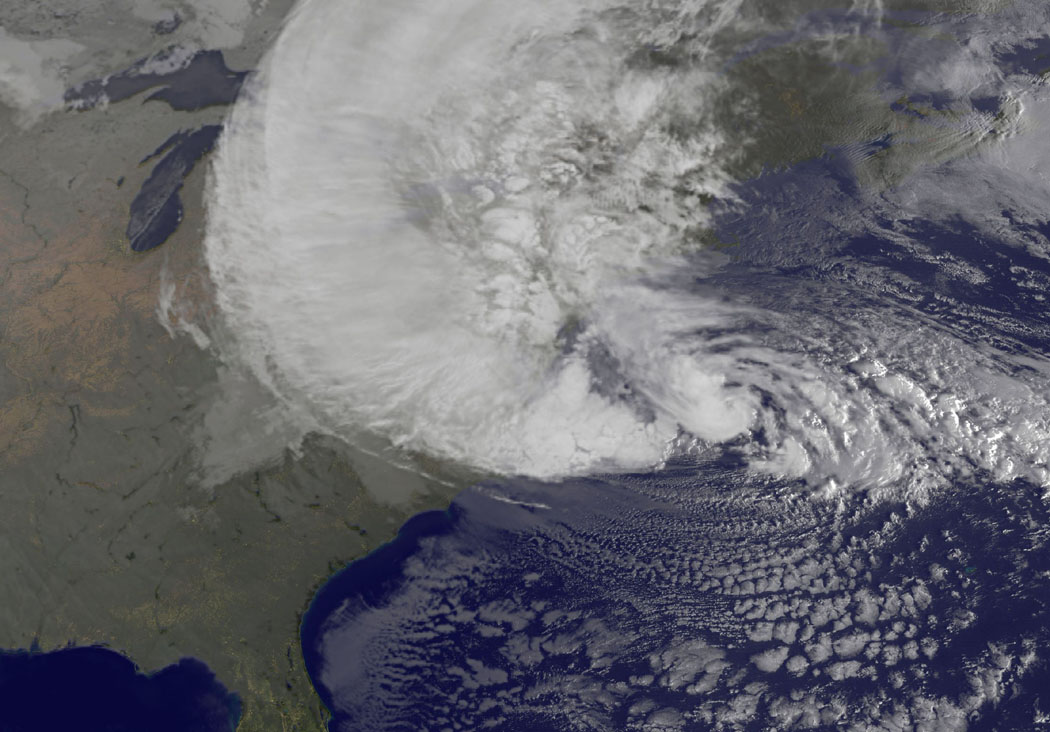
Climate scientists have not yet reached consensus about whether global warming will tend to increase or decrease the total number of hurricane-strength storms. But there is strong agreement that warming creates the conditions for larger and more powerful hurricanes: warmer sea surface temperatures, higher sea levels and more moisture in the atmosphere. These general tendencies interact with other local and regional factors to produce the local weather.

Climatologist Kevin Trenberth parses the specific conjuncture that intensified Hurricane Sandy: ‘The sea surface temperatures along the Atlantic coast have been running at over 3C above normal for a region extending 800km off shore all the way from Florida to Canada. Global warming contributes 0.6C to this. With every degree Celsius [of warming], the water holding of the atmosphere goes up 7%, and the moisture provides fuel for the tropical storm, increases its intensity, and magnifies the rainfall by double that amount compared with normal conditions.’


In the week or so before Hurricane Sandy pummeled the northeast US, the warming denial industry was hard at work. The right-wing, Koch-funded Cato Institute (publishers of In Defense of Global Capitalism, among other dismal screeds) attempted to sabotage a US government assessment of climate change impacts by issuing what poses as an ‘addendum’ to the original. The 2009 report, Global Climate Change Impacts in the United States, was prepared by the US Global Change Research Center and presented to Congress as a summary of the ‘best science’ on the subject. The authoring federal entity is itself a conglomeration of thirteen departments and agencies, including the National Science Foundation, NASA and the Smithsonian Institution,  but also others, like the Environmental Protection Agency, that are routinely contained by hostile political appointments, as well as a battery of agencies straightforwardly in the business of promoting or defending the status quo of accumulation (Departments of Commerce, Interior, Energy, Defense and State, and the Agency for International Development). One can only imagine the pressures and internal struggles that shaped the publication of this report.

Monday, October 29, 2012

administering biodiversity


‘Extinction rates are rising by a factor of up to 1,000 above natural rates. Every hour, three species disappear. Every day, up to 150 species are lost. Every year, between 18,000 and 55,000 species become extinct. The cause: human activities.’
- Ahmed Djoghlaf, head of the UN Convention on Biological Diversity.

The problem, again: The interconnected ecosystems that make up the biosphere are all dependent on the capture, conversion and distribution of the sun’s energy through the planetary cycling of carbon. The biosphere has proved to be fairly resilient. Within the constraining parameters of life on earth, however, changes in climate can have enormous consequences. Interventions, human or non-human, that impact ecosystems and the carbon cycle can result in irreversible losses of biodiversity and trigger abrupt and uncontrollable climate changes. The contemporary form of human society – the global social process we know as capitalist modernity – has initiated both a new mass extinction event and global warming. As a result, tens of thousands of life forms will be ‘disappeared’ and millions of people will lose, directly or indirectly, their lives, health or homes through famine, drought, illness and war. These processes are already unfolding. The urgent question is: how far will they go?

Put differently, the problem is the dominant social process and the difficulty in changing it. The social process, organized to maximize capital accumulation and channeled through a rivalrous interstate system, compels all individuals to compete for places in a national economy and compels all states to promote and defend one national economy against all others. Growth, measured in Gross Domestic Product, is a given. By this logic, capital and biosphere are caught in a relation of antagonism, setting up endless and dreary struggles between the claims of jobs and environment, profits and endangered species, consumption and biodiversity. Through this optic, climate change and mass extinction are simply matters of national security and risk assessment. It is taken for granted that science and technology will enable human adaptation to ecological degradation and the weather. The national security-surveillance state is oriented toward enforcing the current social logic, not changing it. The state’s concern is: who can dominate in the new climate scenario? Or in other words: what must be changed, in order to keep in place the current regime of accumulation and logic of domination? Seen from below, however, the problem is how to change that very logic.

Wednesday, October 24, 2012

greening documenta?

Kristina Buch, The Lover, 2012
Radical Camouflage at Documenta 13
 

by Julian Stallabrass


Documenta, held every five years in the central German city of Kassel, is the art world’s equivalent of the Olympics. While its scale may be rivalled by Venice, its five-yearly timetable and large budget allow curators time to develop an elaborate vision, and it has often been used to test the temperature of contemporary art production. Some previous editions have been very influential in changing the direction of the art world—for instance, Catherine David’s Documenta X and Okwui Owenzor’s Documenta XII did much to push it towards documentary and a greater engagement with politics.

The unusual situation and history of Documenta has haunted many of its editions, including the one currently on show. Kassel is a smallish industrial city set in hilly and forested countryside. In the Second World War, it produced planes and tanks, and it is still a production centre for Germany’s main battle tank, a fact that has not escaped Kassel’s Occupy protestors. The city was repeatedly bombed by the RAF, and extensively destroyed, with thousands killed and many more made homeless. As with so many German cities, its modern centre is the product of that destruction, and its few older buildings were those considered worth restoring from ruin. Documenta, founded in 1955, was from the beginning seen as a restoration of Nazi cultural wrecking, and its first edition showed works of classical modernism which had, of course, been condemned by the Nazis as ‘degenerate’. They were shown in what remains the main venue of Documenta, the Fridericianum, which then still bore some of the marks of war damage.

The current Documenta—or dOCUMENTA (13) if you follow the rubric of its branding—is a vastly ambitious attempt to influence the course of art and culture as a whole. Its curator, Carolyn Christov-Bakargiev, using a frame of reference that takes in phenomenology, quantum theory, feminist thinking and psychoanalysis, wants to push the centre of human cultural concerns away from simple subject-object oppositions towards a perspective that would take in the viewpoints of all entities, living and inorganic. If matter has an intricate connection with information, at least at the quantum level, then all entities may be said to communicate and even to have will. In recounting a failed attempt to have the world’s heaviest meteorite shipped across the world for display at Documenta, Christov-Bakargiev is led to ask, not just what she wanted or what the rock’s custodians (the indigenous Moqoit people in Argentina) wanted, but what it wanted:

'It had traveled through vertiginous space before landing on Earth and settling. Would it have wished to go on this further journey? Does it have any rights, and if so, how can they be exercised? Can it ask to be buried again, as some of the Moqoit argue, or would it have enjoyed a short trip to an art exhibition, rather than a science or world’s fair?'

This thinking is used to prop up a series of gestures towards radical positions: environmental, activist, participatory, anti-war, and in the defence of various minorities. In all this, it is paramount that there must be no ‘closure’, no settling and no agreement: rather a dissonant dance of beings and objects in which all perspectives are acknowledged in an ‘anti-logocentric’ frame.

Sunday, October 14, 2012

reflexive domination and plastic soup

Photo: Mandy Barker
Truth is timeful; history is its core and index. So taught the first generation of Frankfurt Institute thinkers - Benjamin, Adorno, Horkheimer, Marcuse. In keeping with this temporal truth notion, critical theorists today continuously rethink and revise their concepts in light of a dynamically unfolding social process. The master logic of that process may persist as a static essence of domination, but its specific appearance-forms emerge within a lived spectacle of kaleidoscopic flux. In a stimulating essay included in Critical Ecologies (Toronto UP, 2012), Christoph Görg discusses some recent efforts to rethink the dialectic of enlightenment.

Görg thinks the human relation to the biosphere is changing in some subtle ways, and he calls for a nuanced analysis of the domination of nature. As the ecological crises become increasingly undeniable, he argues, elites are responding in ways that cannot be characterized as simple denial or disavowal. In the post-Fordist phase of capitalist accumulation, the historical attempt to achieve utter or complete mastery of nature is finally understood to be impossible, according to Görg. Instead, technocrats and CEOs now try to master the unintended negative consequences of the failing forms of the attempted mastery of nature. But this ‘mastery of secondary effects’ or ‘reflexive domination of nature’ is a strategy of risk management that does not give up the goal of capital accumulation. The master logic remains the same, but the degrading biosphere is now addressed as an assessable risk or ‘security problem’ that must be coped in order to sustain the expectation of high returns on investment.


Photo: Mandy Barker
This reflexive domination of nature increasingly takes the form of so-called ‘ecological modernization’ and ‘greening of capitalism’. Techno-fixes are sought for the new problems that emerge continuously from the violent interface with the biosphere, which still is not acknowledged as a non-identical end-in-itself. In critiquing these pseudo-solutions, then, we need to acknowledge that capitalist technocracy does not have a single, unified position or strategy with regard to biospheric meltdown. A vast range of responses are being put into play, which must be analyzed within the specifics of local contexts and social force-fields. The emerging tendency, a reading of Görg suggests, is risk management through the ad hoc remediation of negative consequences, as these come into view.

Friday, October 5, 2012

review: wilson on the mass extinction


Review: Edward O. Wilson, The Future of Life (Little, Brown, 2002)

‘Although it is possible to predict species extinction for the near future – say, over the next decade or two – such a projection is impossible for the more distant future. The obvious reason is that the trajectory depends on human choice. If the decision were taken today to freeze all conservation efforts at their current level while allowing the same rates of deforestation and other forms of environmental destruction to continue, it is safe to say that at least a fifth of the species of plants and animals would be gone or committed to early extinction by 2030, and half by the end of the century. If, on the other hand, an all-out effort is made to save the biologically richest parts of the natural world, the amount of loss can be cut by at least half.
     – Edward O. Wilson, The Future of Life (pp. 101-2)

 
This is, I am obliged to say right away, my first reading of a book by Edward O. Wilson. I can’t say it is my first encounter, for I have met this name many times already. Wilson is one of those prolific scientists whose presence and influence has grown far beyond his area of specialization (myrmecology, the study of ants) and has attained enough aura and eminence, within the mediations of spectacular culture, to enable him to act as that rarity, a public intellectual: someone whose views and assessments are widely disseminated and may actually count for something in the deliberations of policymakers and even, perhaps, in the formation of so-called public opinion.

I read this book to learn more about the loss of biodiversity and the extinction of species. In particular, I wanted to know what is behind Wilson’s assertion, often cited in the literature around extinction, that if nothing is done to counteract current trends, we can expect to lose half of all present life-forms by the end of the twenty-first century. This book certainly clarifies his position and provides all the evidence and steps that led him to this shocking prognosis. The gyst is in the citation above, and I discuss Wilson’s prescriptions for the conservation of global biodiversity at the end of this review.

Friday, September 28, 2012

review: nicholsen on the bio-meltdown


Shierry Weber Nicholsen, The Love of Nature and the End of the World: The Unspoken Dimensions of Environmental Concern (MIT Press, 2002)

Those concerned and alarmed by the biospheric meltdown need to understand the obstacles that are blocking effective responses. These obstacles are mainly of two kinds: social and psychological. The unsustainable logic of accumulation that drives our contemporary capitalist society is also driving the biospheric crisis. But to change this logic would be to change the form of society itself. To do that, we would have to overcome formidable processes of social reproduction, including the addictive enjoyments of commodified life and the coercive enforcements of war machines and state terror.

The psychological blockages are no less formidable. To respond effectively to catastrophic ecocide, we would first need to bring it fully to awareness and attention. The extent of the damage being done is staggering and the implications are intimidating. We would need to acknowledge the destructiveness of our current way of life and our own deep implication in the global social process. Such awareness is painful and distressing. The feelings of fear, anxiety and guilt it may arouse are so threatening, in fact, that they provoke all our psychic defenses: we avoid this awareness by repressing and disavowing it, or by projecting it outward in the form of more violence or self-violence.


Sunday, September 23, 2012

elegy for an albatross

 
A juvenile albatross desiccate on sand, feathers cupping the fist of flotsam that starved it. As the biosphere melts down and species disappear forever, Chris Jordan documents the real appearance-forms of accumulation. On Midway Atoll (Pihemanu Kauihelani in Hawaiian), in the middle of the North Pacific, he photographed the carcasses of albatrosses killed by plastic. These are hard images, documents of barbarism in Benjamin’s sense: alarms that call us to awake.

This archive, which Jordan subtitles Message from the Gyre, is a lesson in dialectics. In a forensic sense, these images are evidence of a deadly process: capitalist modernity interacting with and transforming ‘nature’. In the commodity, capital animates and inspirits dead things with living relations: they are made to move and dance and flow on a global scale. Here, in these images, we can see in a flash the terrible, indifferent truth of this social process: accumulation, our master, grows within life like an incubus. The commodity – or its traces and refuse – acquires its life at the expense of life, a process that ends in the starvation of living things and the slow disappearance of life-forms. Modernity has launched a new mass extinction event, which now, steadily, comes into view.

Friday, September 21, 2012

capital and biosphere


Modernity and Biospheric Meltdown:
Rethinking Exits, Austerities and Biopolitics

by Gene Ray


In setting out the agenda for this conference, Yannis Stavrakakis calls for a critical and postcolonial reflection on the Greek crisis. He asks us to think about the current politics of debt and austerity within the historical force-fields of “Heterodox Modernity”: “A global crisis provides the opportunity for the enforcement of one more project of ‘modernizing’ Greek culture under circumstances of a quasi-state of emergency.” The terms constellated in this formulation point me to the emerging crisis within modernity itself.
    
My thesis here is that modernity exists but cannot be sustained. It stands exposed today as untenable and unviable – indeed, terminally so. Why? For all the good old reasons set out by critical theory long ago, but also, now, for some new ones. Today, biospheric or ecological meltdown and mass extinction announce the end of modernity. Our challenge now is to rescue ourselves from it: we need an exit from the logic it imposes, not a fix that would prologue it.
    
Given the stakes, which I clarify below, this challenge should be at the very center of political discourse and debate. It should be included now in every serious discussion about the so-called sovereign debt crisis, or art, or the postcolonial. Instead, we continue to leave it out. For many reasons, we’re avoiding this challenge. It’s too huge, too unthinkably catastrophic, too difficult and uncomfortable on so many levels. But avoidance and disavowal won’t make the biospheric crisis go away. It will impose itself now as the absolute material limit of modernity – the real constraining objectivity that will shape all politics, all possible futures.

Friday, December 24, 2010

normalizing catastrophe


Normalizing Catastrophe: Cancun as Laboratory of the Future  
         
by Eddie Yuen


Sixty-five million years ago, an asteroid crashed into what is now the Yucatan Peninsula of Mexico and rendered extinct 70% of all life on Earth. In December of 2010 in Cancun, a mere geological stone's throw from the Chicxulub crater that ended the reign of the dinosaurs, a conclave of political and corporate leaders presided over a conference that failed to slow down the next great extinction event on this planet.

But for this geographic coincidence it's unlikely that this conference will be remembered as anything more than another tedious and predictable step towards a future of managed climate chaos and accelerated global enclosures. Cancun is most significant, though, not as the scene of a crime but as a laboratory of climate apartheid. Whatever fearsome predation the Yucatan of the late Cretaceous may have harbored, the Cancun of the early Anthropocene is the model of a naturalized social order even redder in tooth and claw. Even to use the language of "climate talks" is like speaking of the Israeli/Palestinian peace process. As linguist Noam Chomsky said years ago, the mere utterance of this phrase validates the discourse that there is such a process.

This particular conference, rightfully overshadowed by the Wikileaks saga, was both anti-climactic and anti-climatic, in the words of Laura Carlson, director of the American Policy Program in Mexico City. The Indigenous Environmental Network summed it up nicely: "The Cancun Agreements are not the result of an informed and open consensus process, but the consequence of an ongoing US diplomatic offensive of backroom deals, arm-twisting and bribery that targeted nations in opposition to the Copenhagen Accord during the months leading up to the COP-16 talks".

Sunday, September 19, 2010

micro air vehicles

Recent prototype of the Harvard Microrobotic Fly, a three-centimeter wingspan flapping-wing robot. (Credit: Ben Finio, The Harvard Microrobotics Lab)

The following "article" appeared on TerraDaily, a digest of ecology-oriented reports and snippets. While what and who is behind the website begs investigation, the entity and intentions behind this report are clear enough. It is reposted here as a social fact; critical reflection follows on in the next post.


Tiny MAVs May Someday Explore And Detect Environmental Hazards

by Maria Callier
Air Force Office of Scientific Research

Arlington VA (AFNS) Sep 16, 2010
Air Force Office of Scientific Research-sponsored researcher, Dr. Robert Wood of Harvard University is leading the way in what could become the next phase of high-performance micro air vehicles for the Air Force.

His basic research is on track to evolve into robotic, insect-scale devices for monitoring and exploration of hazardous environments, such as collapsed structures, caves and chemical spills.

"We are developing a suite of capabilities which we hope will lead to MAVs that exceed the capabilities of existing small aircraft. The level of autonomy and mobility we seek has not been achieved before using robotic devices on the scale of insects," said Wood.

Wood and his research team are trying to understand how wing design can impact performance for an insect-size, flapping-wing vehicle. Their insights will also influence how such agile devices are built, powered and controlled.

"A big emphasis of our AFOSR program is the experimental side of the work," said Wood. "We have unique capabilities to create, flap and visualize wings at the scales and frequencies of actual insects."

The researchers are constructing wings and moving them at high frequencies recreating trajectories similar to those of an insect. They are also able to measure multiple force components, and they can observe fluid flow around the wings flapping at more than 100 times per second.

Performing experiments at such a small scale presents significant engineering challenges beyond the study of the structure-function relationships for the wings.

"Our answer to the engineering challenges for these experiments and vehicles is a unique fabrication technique we have developed for creating wings, actuators, thorax and airframe at the scale of actual insects and evaluating them in fluid conditions appropriate for their scale," he said.

They are also performing high-speed stereoscopic motion tracking, force measurements and flow visualization; the combination of which allows for a unique perspective on what is going on with these complex systems.

The original article on TerraDaily.

drones of disaster (2): eco-erotics perverted


"A million technocrats are diligently plotting death and some of them even know it." (Pynchon, Gravity's Rainbow)

The playful imitation of nature relates to nature without dominating it: mimesis, sublated in the forms and impulses of art, performs the promise of nature’s liberation. This idea is what Benjamin and Adorno tried to rescue from Romantic aesthetics. Adorno retains mimesis as an irreducible moment of play within negative dialectics, or thinking rigorously oriented toward non-identity. Mimesis becomes a principle guiding rigorous imagination, that attentive immersion in non-conceptuals, singularities and particulars that releases the social truth of objects without bombing and gassing them.

If astonishment at nature inspired early science, its modernist form, struggling to liberate thought from superstition, aimed to repress all traces of play within its own methods. Under capital, mimesis returns as one more means of domination. The dragon-slayers went to work for the dragons, and dragonflies droned airborne from the labs of engineers.

Over the skies of the walled border with Mexico no less than in the Afghan mountains and flooded valleys of Pakistan, we are seeing where this leads. The war machine has let slip its dreaming of bee-sized killer drones, and already some years have passed since we heard tell of strange dragonflies shadowing antiwar demonstrations. Knowing well how the Pentagon takes its dreams for reality, we can feel the chill in the warming air.

And as always, every leap in domination is sold to us as its opposite. In the aftermath of Hiroshima, the US state used the promise of the “peace atom” to mystify the terror of the “war atom.”

All these processes are legible in the short and glowing report that appeared on a remarkable website called TerraDaily (“news about planet earth”). It is re-posted in full above, minus the ads by Google. Are you worried about the biosphere? Have you been sensitized to the global threat? Be reassured, rare and gifted minds are at work at Harvard and Los Alamos. This little gadget, miracle of nano-science, epitomizes the good micro-robotics. This is “research on track to evolve into insect-scale devices for monitoring and exploration of hazardous environments, such as collapsed structures, caves and chemical spills.” Don’t be alarmed that the sponsor of this project and employer of the "journalist" is the US Air Force Office of Scientific Research. Science is humane, after all; it will rescue us from hazardous environments, whether or not it was instrumental in producing them in the first place.

Everything about this report betrays the perverting of eco-erotics, the channeling capture of the legitimate human longing to be reconciled with exploited and dominated nature. Militarized and capitalized, science forfeits its notion of truth as liberation; in its place is the correspondence between the means and end of domination. But the untruth of antagonism, which the given production produces at every level, remains the glaring truth about the global social process. In that process, nature is no less commodified and exploited than labor power, and with reverberations that are no less planetary. But even perverted, mimesis preserves a promise of reconciliation – freedom, sensual happiness and the liberation of inner and outer nature.

But only as a promise. Its realization is the real struggle from below.

Sunday, September 12, 2010

on nature & postcards from poseidon


Nature and the human: mythical poles of an actual dialectic, a process of metabolic exchange that is neither natural nor entirely social.

Adorno, stimulated by Benjamin as well as Marx, tried to work out the forms and variations of this dialectic under the paradoxical heading of "natural history." Today they bear down with bitter clarity.

Nature is the material rock bottom of mortal bodies in cycling flux: the ceaseless conversion of matter and energy that is both the astonishing beauty of bonding webs and the liquidating sublimity of death's heads.


History - the idea, produced in time, of freedom - promises escape from nature as blind fate: human reason begins as protest against imposed structural impotence.

But what reason rescues from domination by nature is rapidly converted into new domination over nature and people: freedom is taken hostage by power.


History, stuck in domination, renounces liberation: not yet historical, not nearly rational enough, the social process remains naturalized, the reproduction of mythical second nature.

As global social process, capital gives specific form to reason, science, technology, power, the state: the valorization-accumulation process produces and reproduces the order of exploitation, enforced by state terror and weapons of mass destruction -- a dynamic of domination that escapes rational control.

Moreover, the social form of mortal human bodies impacts the forms and tempos of metabolic flux: society changes nature.


Class domination of man by man and the rape and plunder of nature are a single global process, escaping reason on planetary scale: under the rule of accumulation, ecological degradation accumulates to the point of looming biospheric meltdown.

But this second nature is not natural: neither invariable nor inescapable, it is the mirage of fate spreading before a relentless and gripping social process that could be otherwise.


The abundance that reason and the power of production dangles in view but does not deliver is the actual possibility of reconciliation between humanity and nature, as well as between humanity and itself: the liberation of inner and outer nature.

However, emancipating transformation of the social process remains the only pathway to such liberation: a history that would break with capitalism's "ever changing production of the always-the-same."


In the unbroken persistence of domination, the promised progress in freedom and happiness remains blocked.

But now accumulation recoils, threatening the conditions of life as such: under capitalist modernity, leaping development overleaps itself, and becomes terminal.


The process is open - meaning: no outcome is pre-given or automatic.

But: time itself is a limiting constraint. We will not have forever to find the passage beyond capital, domination and terminal ruin.

A century ago, these theses were mere science fiction; now they are urgency itself.


Nature and history (or: the human), then, are inseparable non-identities: each conditions and mediates the other in actual process, just as each conceptually de-mythifies the other by continuous specific negation.

They are, as Susan Buck-Morss puts it, "mutual, non-identical mediators."  In constellation with other concrete dialectical couples (individual/society, subject/object, particular/universal), they form the tensional matrix of possible practice.

The radical embodiment of negative dialectics would be the revolutionary practice Adorno's thinking reached but did not become. We are still in that "would be."

GR


Friday, June 4, 2010

beyond enforcement


Beyond Enforcement:
Traversing State Terror and the Politics of Fear

by Gene Ray

Crises arrive, as if from somewhere, fall like night, bear down, take hold, bite like jaws of teeth, squeeze like vises, break like storms or bubbles: effects ripple pitilessly, positions crumble, assets vanish in a spreading slippage, a sucking from below, an awful culling of the weak and exposed. Planetary meltdowns loom, impend.  Economies grow, and slow, but must grow, must be made to grow, to expand, spiraling incessantly, an immense entwining of flows, the dance of commodities, the “ever new production of the always-the-same.” And resources deplete, oil produced over millennia is turned to fume in two centuries, atoms are split, waste accumulates, like a darkening shadow, a hovering toxin, another ghost of capital. And still the frenzied racing, the rivaled eyeing, muscles flexing, markets judging, terminal arsenals still on fifteen-minute alert, a world awash in arms, skies filling with terminator drones.
    
Within a given social process, a field of forces and relations in motion, one generated tendency becomes a dominant, mastering logic. One antagonistic logic, a calculus of advantage, a mode of instrumental reason joined to a relation of domination, spreads, expanding its field, overtaking, overwhelming, deranging, pulverizing, liquidating whatever constrains it, consolidating, entrenching, and becomes global – the master logic of a global social process. And reason thereby recoils, becomes unreason, hostile and heedless, eating its own tail. Capitalist modernity and the social world, ours, it has produced: a world turned against its producers escapes all control, is seen finally to have been a terminal, omnicidal logic, busily, blindly undermining its own conditions, the ecological basis, biosphere, the condition of life on earth.