Showing posts with label ciphers. Show all posts

Monday, October 29, 2012

administering biodiversity


‘Extinction rates are rising by a factor of up to 1,000 above natural rates. Every hour, three species disappear. Every day, up to 150 species are lost. Every year, between 18,000 and 55,000 species become extinct. The cause: human activities.’
- Ahmed Djoghlaf, head of the UN Convention on Biological Diversity.

The problem, again: The interconnected ecosystems that make up the biosphere are all dependent on the capture, conversion and distribution of the sun’s energy through the planetary cycling of carbon. The biosphere has proved to be fairly resilient. Within the constraining parameters of life on earth, however, changes in climate can have enormous consequences. Interventions, human or non-human, that impact ecosystems and the carbon cycle can result in irreversible losses of biodiversity and trigger abrupt and uncontrollable climate changes. The contemporary form of human society – the global social process we know as capitalist modernity – has initiated both a new mass extinction event and global warming. As a result, tens of thousands of life forms will be ‘disappeared’ and millions of people will lose, directly or indirectly, their lives, health or homes through famine, drought, illness and war. These processes are already unfolding. The urgent question is: how far will they go?

Put differently, the problem is the dominant social process and the difficulty in changing it. The social process, organized to maximize capital accumulation and channeled through a rivalrous interstate system, compels all individuals to compete for places in a national economy and compels all states to promote and defend one national economy against all others. Growth, measured in Gross Domestic Product, is a given. By this logic, capital and biosphere are caught in a relation of antagonism, setting up endless and dreary struggles between the claims of jobs and environment, profits and endangered species, consumption and biodiversity. Through this optic, climate change and mass extinction are simply matters of national security and risk assessment. It is taken for granted that science and technology will enable human adaptation to ecological degradation and the weather. The national security-surveillance state is oriented toward enforcing the current social logic, not changing it. The state’s concern is: who can dominate in the new climate scenario? Or in other words: what must be changed, in order to keep in place the current regime of accumulation and logic of domination? Seen from below, however, the problem is how to change that very logic.

Thursday, March 11, 2010

which terror trumps?


State terror: terminal powers of enforcement.

Auschwitz: objective demonstration of a new state power, administrative-industrial genocide.

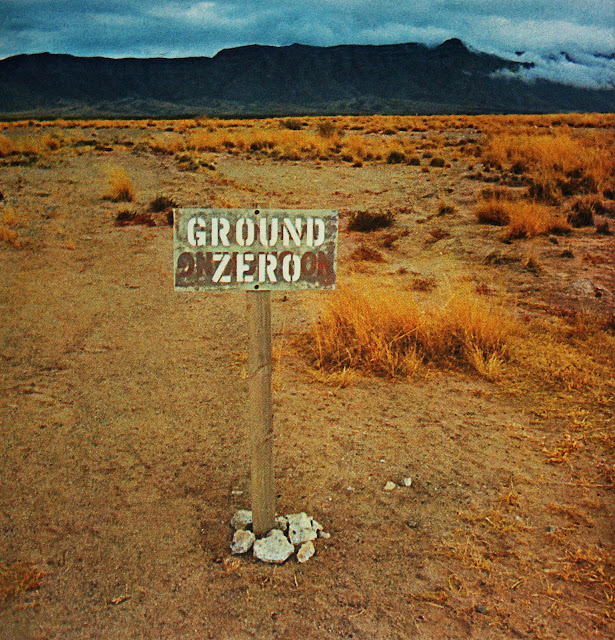
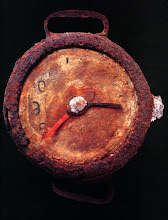
Hiroshima: objective demonstration of another new state power, the Weapon of Mass Destruction that self-justifies the merger of science and war machine.

Political necessity of the new regime of exception: an absolute enemy, someone, somewhere, preferably a dark bearded face, an imago to be targeted with trembling and enjoyment, the terminating focus of all displacements in the politics of fear.

This is how the capitalist process reproduces and enforces its own conditions today. And new techno-powers now emerging may also prove qualitative: killer drones and terminator robotics combining with god’s eye satellite and internet surveillance.

Through the chains of mediation – administration, integration, culture industry, spectacle, biopower, “war on terror” – state terror points back to the valorization-accumulation process driving our commodity world, the master logic of capitalist modernity.

But now a new factor points more immediately to the same master logic: collapsing ecologies, degradation and depletion, species extinction and climate change.

In the form of looming planetary meltdown, the capital accumulation process itself becomes directly genocidal.

The more the economies grow, the warmer it gets perforce, sentencing more to misery and death, bringing us all closer to critical tipping point. But in a capitalist world, economies that don’t grow also mean unemployment, misery and death: neo-imperialist war machine.

The alternative to this viciously self-terminating “progress”: global reorganization, collective passage to non-domination, a sustainable social logic.

Formerly, in Marxist vision, this passage was the leap to freedom. Today, the urgency with which it begins to bear down makes it appear rather on the side of constraint: the rational self-constraint now demanded by the same instinct for self-preservation that long ago reversed into its irrational opposite.

Benjamin: revolution as the emergency brake on a runaway train.

The actual problem we face: how to organize the reorganization in a non-catastrophic way.

Eros, the liberation of nature, passes through the passage to classless society, but does not end there.

Ecological meltdown begins by impacting us differently but must end by imposing humanity on us indifferently. Could this constraining imperative then bypass the class struggle, realizing its aims more directly?

Maybe, but not likely, so long as the entrenched regime of class relations retrenches and enforces, as it now is doing.

Which terror trumps? Monstrous question for politicized erotics.

missed tooth?


It’s too easy, White warns us, to simply dismiss Hirst, through an annihilating critique that fails to confront the real fascination operating in his art.

Point taken. And White’s discussion of the antagonisms staged in For the Love of God is strong and convincing. To make these antagonisms visible and available to reflection already pierces its glittering halo, without failing to give the devil his due.

My reservation: today the link between capital and death is even deeper than White registers. Capital has become in actual fact what it always was potentially: a techno-genocidal automaton busily destroying the very conditions of life. Or rather, and more horribly, compelling each of us to contribute to this process, and thus surrender, every day of our lives.

What speaks mutely in many of Hirst’s works is a coldness, an absence of life and warmth – the coldness of an objective process we have for decades been helpless to restrain or change.

There was a moment in postwar culture when this coldness was mirrored effectively as a critical artist means. That was the bite of dissonant modernism. But compared to Hirst, even Beckett’s stare is a warm and compassionate protest.

There is no protest to Hirst’s coldness. It mirrors, but without a trace of that passion or compassion that leads us back to each other in urgency. This lack of heart, this absent clenched fist of humane outrage at our present impotence, is the missed encounter at the heart of Hirst’s work. It marks not just Hirst’s failings as an individual artist, but the crystallized failure of a whole historical moment.

Needing heart, needing warmth, as well as honesty and truth, from anything that would call itself art, now more than ever, what shall we say to or about skulls that leave us “blinking, dazzled, and bemused” but not warmed or more human?

Speaking of Hirst, should we not ask this, as well?

“The yawning jaws, the wreathed lips, the enormous teeth, the bulging eyes, composed a striking death’s-head....The mule, in his opinion, had died of old age. He had bought it, two years before, on its way to the slaughterhouse. So he could not complain. After the transaction the owner of the mule predicted that it would drop down dead at the first ploughing. But Lambert was a connoisseur of mules. In the case of mules, it is the eye that counts, the rest is unimportant. So he looked the mule full in the eye, at the gates of the slaughterhouse, and saw that it could still be made to serve. And the mule returned his gaze, in the yard of the slaughterhouse....I thought I might screw six months out of him, said Lambert, and I screwed two years.”

Beckett, Malone Dies, 1952/56.

(Photo: Damien Hirst, A Thousand Years, 1990)

Monday, March 1, 2010

refracting terror


“Somewhere in the heap, a wild equine eye, always open.”
Beckett, The Unnamable, 1953/58

As the wars went on, missiles and phosphorous pounding down on civilians across the Global South, computer animator Lena Gieseke mapped the space of Picasso’s great protest of the terror wreaked on Guernica.

Not unproblematic, her technical “exploration.” The last thing we need is another cartoon trivializing what weapons keep doing to bodies. (Nor does Picasso escape this old problem of the enjoyment factor intrinsic to aesthetic semblance, at work in all images, even painful representations of the worst.) 

But her risky estrangement convinces – and the more so by not reassuring. She fingers the questions raised, without pretending to fix the relation between her “three-dimensional reproduction” and Picasso’s painting. The haunting result disturbs on many levels, even as it activates the image shards of horror all of us are forced to carry in our heads.

Wednesday, February 17, 2010

allegory and automaton


The opening thesis of Benjamin’s celebrated last essay controversially poses a strategic alliance between “historical materialism” and theology.

Benjamin describes an elaborate eighteenth-century stage machine, the basis of a popular traveling show. This chess-playing automaton reduces to four elements: chessboard, “system of mirrors,” “puppet in Turkish attire” and “hunchbacked dwarf.”

Under Benjamin’s interpretative labor, each element generates a second, allegorical meaning, and the apparatus takes on philosophical status. The chessboard becomes the field of class struggle. The mirrors stand for the system of illusion that obscures what really takes place. The Turk becomes “’historical materialism’,” and the dwarf personifies theology.

Systematic deception makes it appear that “historical materialism” assists the exploited in their struggle. What actually happens in Benjamin’s allegorical image is that theology, concealing itself, gives its services to the exploited by manipulating the machinery of illusion and pulling the strings of “historical materialism.” This hidden, guiding infiltration of theology supplies the winning combination.

Benjamin’s quotation marks signal that something is fishy with historical materialism, or what goes by that name. A critique of pseudo-materialism will unfold in subsequent theses: Benjamin will distinguish a fraudulent “historical materialism” in the working class parties from one truly animated by Marx’s solidarity with the exploited and oppressed.

But keeping now to Benjamin’s formulations in the first thesis, we could pose some complicating questions:

In the allegory, the dwarf of theology is the only visible locus of autonomous agency. Benjamin encourages us to infer two more: the antagonists of class struggle, labor and capital. But strictly speaking, neither has substantial presence or determinate agency in the image. Both are merely implied by the relation between a present agonic field, the chessboard, and the identity of the puppet, “’historical materialism’.”

The distribution of agency appears to open up a problematic that exceeds the configured elements of the allegory itself.


The eighteenth-century stage machine, called the Chess Automaton or Turk (Schachtürke in German), is, to use I.A. Richards’ terms, the vehicle of the allegory. The philosophical counterpart is the tenor.

Let’s play along with Benjamin and immerse in this image. In the historical vehicle, the touring stage show performed for a paying public of amazed and suspicious spectators, one of whom must step from the crowd to become the Turk’s opponent.

Such an opponent – clearly an autonomous agent vis-à-vis the Turk-Automaton – is entailed by the set-up: the show makes no sense otherwise.

If we then infer, as we must, such an opponent for the tenor as well, then we have the collective subject-position of capital in the class struggle – or in a longer vantage, the exploiter-oppressor, whatever the mode of production. (Or, to take its actual appearance-form as Benjamin was writing, Nazism.) But then where do the exploited sit? They cannot be identical with “historical materialism.” At most, this last merely claims to represent the interests of the exploited. And fraudulently at that, for the puppet is actually part of the machinery of deception.

The exploited and oppressed seem to be excluded from any active agency in the game – not at all what we would expect!

Perhaps Benjamin wants to say that the system of deception denies the exploited their potential historical agency and that the infiltration of “historical materialism” by theology creates an opening to agency. But in that case, the allegory would hardly represent a corrected concept of history, since now the theological dwarf is standing in for the exploited – a substitution rather than empowerment or self-empowerment.


A real problem emerges around the agency-subjectivity of the exploited and the status of the deceptive apparatus itself. What really is Benjamin asking us to imagine and consider?

Edgar Allen Poe saw the real machine in action in Richmond. In his short story, “Maelzel’s Chess-Player” (1936), he attempts to establish the necessity of a hidden human agent. “It is quite certain,” he writes, “that the operations of the Automaton are regulated by mind, and by nothing else. Indeed this matter is susceptible of a mathematical demonstration a priori. The only question then is of the manner in which human agency is brought to bear.”

Indeed, what is an automaton? A machine that expends inputs of energy in a pre-programmed way, like a wound-up clock? Or a code, a string of ones and zeros, like the chess software you may have on your laptop?


The question points, quickly enough, to the problem of freedom that constitutes the concept of history.

In volume one of Capital, Marx shows how labor-time systematically stolen in commodity production is the source of all surplus value. Value (Wert), socially-necessary labor-time, emerges from the unfolding logic of exchange itself, as it transforms production into commodity production; labor-power takes the form of the value-producing commodity. Surplus value is extracted from the production-exchange process to the degree that wages are kept below the value that labor produces. Capital emerges as a new factor as value passes through the forms of money and commodities in exchange, adding to itself with each full circuit.

Capital, then, is “the valorization of value” in a boundless, self-renewing spiral movement: “self-valorizing value” (sich verwertende Wert, chapter four). Capital, Marx writes with legible astonishment, is “the dominant subject” of a self-moving, self-driving, constantly expanding process. It is an “automatic subject” (ein automatisches Subjekt), an “animated, inspirited monster” (ein beseeltes Ungeheuer).

If there is an automaton that dominates history, it is this expansive master logic of capital accumulation, which exerts itself as a constant force of compulsion acting relentlessly on direct producers and capitalists alike.

This logic, the very essence of our global social process, operates “behind the backs” of individuals. History is a blind process, in that it has never yet been consciously directed by human reason; it is rather the effect of that reason separating itself from the will and interests of individuals and asserting itself above and against them.

Reified, this process is experienced by these same individuals as unchangeable second nature, as the real objective power of things and facts that have taken possession of the autonomy promised to human beings.

So far there has been no global human subject, no human agency over the force of blindly operating and endured historical processes.

The exploited and oppressed, as those who have suffered most from this given even as their labor is its absolute condition, are the ever-present potential rupture in a history of continuous, accumulating toil, defeat and oppression.

The possibility that the exploited in struggle will gather their collective potentials and overthrow this logic of domination, Benjamin will reiterate again and again, is the possibility that human agency will emerge for the first time – free human agency in the global sense that alone would constitute a universal history of liberation, of progress in emancipation.

Possibly, then, this is what the tenor of the allegory shows us, by pointing to the need for a critique of pseudo-materialism and to a theological concept of redemption that, for Benjamin, will turn out to include intrinsically the secular concept of revolutionary praxis. This praxis would reflect the true and self-rescuing dialectic of matter and spirit.

This strategic concept of history, on the side of the exploited, is at least suggestively conveyed in the opening allegory – although, unless I’m mistaken, the image generates more questions than it can clearly answer. Answers will come in the subsequent theses, however.

And, needless to say, the problems of agency and praxis within and against a hostile, overpowering automatic process are the ones we actually still face.

(photo: Marc Wathieu) 

Sunday, February 14, 2010

dreaming naked

The antagonism of eros and thanatos is the substance of our species-being, our embeddedness in nature. This was Marcuse’s thesis, the basis of his last aesthetics.

He was pointing to: the irreversibility of time, mortality, transience and inescapable loss, the irreducible misfits of encountering singularities, sexual difference, wounds of love.

These he noted, assert their power “within, but also against the class struggle.”

Is it so? Let’s say it is. What follows?

Drives and needs are structured in a tense configuration of primary processes. This organic constellation - the material basis of subjectivity and therefore also the autonomy of individuals – is not invariable human nature but rather the open point of intersection between nature and the human. Open, that is, to re-constellation, tensions persisting.

Classless society, were it ever attained - or even that stronger reconciliation of a changed, non-dominating relation to nature - would not eliminate all possible collision of drives and needs, the tragic matter of spirit.

But it would, wouldn’t it, eliminate the socially imposed dimension of antagonism: the structural extraction of social surplus value, the master logic of domination?

Art might persist, probably it would – but as something different. A generalized common good, rather than privileged professional property: the end of “art.”

Conceivably, in classless society art could become radically and without reserve what it sometimes is brokenly even now: a continual expression of the dilemmas of liberated happiness - but also the living memory of loss and the appalling misery of prehistory.

Eros: the promise and possibility of a radical reorganization of needs and drives, the taming of death instincts by life, the liberation of the nature in humanity and humanity in nature...

In any case this, and nothing less, would be, wouldn’t it, the radical throw, the revolutionary leap to real reconciliation (aka “freedom”)?

shudders of freedom?

On that point, do Marcuse and Kristeva meet up and party?

Is it otherwise in Adorno, for whom reconciliation would also be liberation from unconsciously endured “natural history” (Marx’s prehistory of naturalized class society)?


Cyclical nature as ecological base and physical rock bottom is the model of archaic fate as blind compulsion, as wheel, vicious circle.


The expanding circuits of capital (M-C...P...C'-M') reproduce, in the second nature of commodified social reality, the spell of wheels that spin but cannot be changed: “the ever new production of the always-the-same,” with its naturalized shadow of misery and unfreedom – actually, so far, permanence in catastrophe, perennial disaster.


Freedom would be the real social reduction of all fraudulent necessity, the conscious openings in the mutual conditioning and reciprocal mediation of nature and history.


This would include the dissipation of blind fate and remnant myth in nature as such – in its “laws” and processes, including enigmas of speciation.


The supercession of nature as spell, as chaining helixes of ideology holding back human possibility. But also, at the same time, the liberation of nature from domination.


Radical ground and overlook on global climate change? Passage to classless production, generalized autonomy and zero-growth economies as firewall against planetary eco-meltdown?


In truth the problem of problems, the liberation from master logics as such, the puzzle of social code beyond DNA...

As it is, science belongs to capital. Techno-power, mediated by antagonism, serves and asserts the power of blind global process over nature and individuals alike – “the progress from slingshot to atom bomb.”

Could be otherwise, but no solution here that is not radically social...

political eros?

Rhythms of Resistance/Action Samba Band Berlin: saving grace of northern demos in grim clime and harried streets...

Radical music or music for radicals? Or both at once: concrete appearance-form of politicized reach, of eroticized radical culture?

Friday, February 12, 2010

executive toothpaste

The merger of emergency executive and war machine within the US state is evidently bigger than Obama.

Tone shifts aside, he and his cabinet have drawn back from draw down.

With only minor, token exceptions and despite the complaints of Republicans, the Obama executive has maintained, reinforced and even continued to expand the apparatus, positions and prerogatives put in place by Bush.

Substantially, the war on terror continues. The politics of fear are played in a pleasingly different key, but one year on the logic of homeland security persists where it matters.

Emergency expansions of executive power, once established, are incredibly difficult to roll back. We would need to imagine the conditions for a transition to democracy in the US analogous to post-dictatorship periods in Spain, Chile or Greece. Leonard Cohen, but where is the struggle?

Carte blanche executive violation of standing treaties, secret presidential programs and expenditures, covert acts of war, normalized assassination and “extraordinary renditions,” suspension of habeas corpus and torture by proxy (all evidently in practice under Obama): whether granted by special authorization of Congress or simply unopposed and unprosecuted, such abuses of law clearly liquidate the Constitution.

They effectively reconstitute a new relation between the branches of government – something only Constitutional amendment could do legally. Checks and balances to constrain arbitrary power have been drastically enfeebled.

Q: So why do Congress and Supreme Court endorse the new regime by a mix of approval, silence and inaction? Why do they not “jealously guard” their own designated powers? Where, the trumpeted instinct for "liberty"?

Why, for example, is Kucinich all alone in crying foul (if that mild aside be a cry).

Is it safer in the dark? Is the new militaristic regime too “popular”? Is the populace asleep, apathetic, distracted, too confused and depressed?

Is it the sum of all these, converging with and reinforcing concentrated economic power - the "nexus of profit and secrecy"?


Given the conditions of winning Congressional elections and reelections, is it preferable to feign blindness and hand over powers at the slightest invocation of security shibboleths?
If so, in what ways? Who gains what, by what process?

And the Court, what is the Court after Bush v. Gore? A degraded reflector of the corporate-partisan force field at any given moment - a belated, arbitrary dialectic between presidential power of nomination and nine mortal lifelines.

A very partial, very unsatisfying hint at the weight and momentum of processes, once the changed facts in the state have taken hold:

“It is often too late for the toothpaste to be put back into the tube.”
Garry Wills, Bomb Power, 2010

Saturday, February 6, 2010

on scurvy music

from On Stupidity in Music, an Imaginary Dialogue (1958)
by Hanns Eisler

If I think of the stupidity in music I am of the opinion that the desperate do find consolation.

But isn't consolation the real aim of art, especially of music?

Concerning consolation, I can tell you something from the secret documents of the Austro-Hungarian state police in the year 1805 in Vienna, which says: "In times like the present, when manifold sufferings affect the character of the people, the police must pay more regard than ever to popular distractions. The most dangerous hours are in the evening. How can these hours be better and more harmlessly spent than by listening to music?"

But Eisler, 1805 was the year Beethoven composed his Third Symphony, the Eroica. Did the police chiefs want the Viennese to listen to this revolutionary music?

You overestimate the intelligence of the state police in 1805.

Is bad music always stupid?

No. Dangerous things are unfortunately mostly not stupid. But now I'll contradict myself and give you something "in praise of bad music." Here's what Proust wrote in Les plaisirs et les jours: "Pour out your curses on bad music, but not your contempt!"