Showing posts with label reviews. Show all posts

Thursday, August 29, 2013

review: AIRossini in berlin


AIRossini: Opera as Critical Entertainment

By Anna Papaeti & Áine Sheil

The death of opera has been pronounced and debated almost since the inception of the art form. Often criticized as a dated and costly medium, monopolizing the majority of state funding for the arts, it appears to be addressed to a small, upper middle-class, elitist and, in most cases, aging audience. This critique is one of the most serious ones faced by opera houses internationally. Despite their many (often imaginative) efforts to attract a wider public through education departments, outreach programmes and technological dissemination (for example, New York’s Metropolitan Opera’s High Definition cinema broadcasts or the Royal Opera House Covent Garden’s Big Screens in public spaces), opera audiences do not appear to be changing significantly in profile.[1] Except in cases where opera houses are heavily subsidized by taxpayers, operatic repertory is essentially focused on popular composers of the canon such as Puccini, Verdi, Mozart and Rossini; Wagner remains for the most part the reserve of larger, better-resourced companies. Although the rise of so-called director’s opera, inspired by Regietheater, has led to more complex and critical opera stagings in continental Europe and to a lesser degree in the UK, many companies shy away from overtly political productions, perhaps for fear of alienating patrons and harming box office returns. The Metropolitan Opera’s recent staging of Wagner’s Der Ring des Nibelungen is telling. Employing an impressive array of new staging technologies, its director, the renowned Robert Lepage, disappointingly chose to convey Wagner’s story in a literal, one-dimensional fashion, minimizing the multi-layered political, social and historical aspects of the work. In effect, this production became part of the culinary culture with which Bertolt Brecht famously associated opera in his essay ‘The Modern Theatre is the Epic Theatre’, written in 1930. For Brecht, opera as an ‘apparatus’ of entertainment establishes an attitude in the spectator that is uncritical and ill-suited to reflection on social and political issues of the day. Its ‘culinary’ aspect leads to an enjoyable intoxication, mainly aimed at pleasure, entertainment and illusion – a criticism he mounted in particular against Wagner’s music drama and the fusion of the arts (Gesamtkunstwerk).[2]


A recent Greek-German collaboration between The Beggars’ Operas, Athens, and Neuköllner Oper, Berlin, brings back to the fore the question of opera’s relevance as a forum for critique, political intervention and debate. Although perhaps not strictly Brechtian, the two productions that have stemmed from this fruitful collaboration have put contemporary politics on stage, clearly taking on board Brecht’s critique of opera. Politics are not staged in the usual manner of a shallow reading of a work, highlighting obvious (often historical) political dimensions. On the contrary, urgent contemporary politics pervade the very core of the two productions undertaken so far, namely Yasou Aida! (2012) and AIRossini (2013). In both cases, Alexandros Efklidis (director), Kharálampos Goyós (composer) and Dimitris Dimopoulos (writer) have used certain core elements of old works, on which they have built a new contemporary story. Musically the works are adjusted for a small stage and a very small orchestra.  In the case of Yasou Aida!, the music of Verdi’s Aida was used along with the opera’s colonial discourse to form the basis of a contemporary story about the economic neocolonializing policies in Europe and the crude national stereotypes stemming from the Greek economic crisis in the era of austerity. It received both box-office and critical acclaim. Glowing media responses were not restricted to cultural columns and were not solely published and broadcast in Germany and Greece (where it was staged), but also appeared in the international media (e.g. BBC News).

Wednesday, November 14, 2012

review: lilley et al on catastrophism


Review: Sasha Lilley, David McNally, Eddie Yuen and James Davis, Catastrophism: The Apocalyptic Politics of Collapse and Rebirth (PM Press, 2012)

     This is the end. My only friend: the end. - JM

Capitalist governance is hardly thinkable today outside the shifting contours of the politics of fear. Terror pulses and surges within the global social process, and anxiety shapes the very forms of contemporary subjectivity. The logic of accumulation dominates through a flexible mix of enjoyment and enforcement. Under the pressures and miseries of social and ecological crises, fantasies of doom animate both the dream machines of the culture industry and the political imaginaries of divergent social movements. To experience collective self-destruction as a supreme aesthetic pleasure, Benjamin noted back at the opening of the new era of terror, is bad politics.


Catastrophism: The Apocalyptic Politics of Collapse and Rebirth offers a superb and needed critical overview of current tendencies toward an aestheticizing politics of doom. Evolving out of discussions catalyzed by Iain Boal and the Retort collective, these essays by Lilley, McNally, Yuen and Davis survey and analyze the traps and delusions involved when catastrophe scenarios are deployed as a mobilizing political figure. Clearly, we need to understand these pitfalls, for as Yuen observes, our moment ‘is saturated with instrumental, spurious, and sometimes maniacal versions of catastrophism – including right-wing racial paranoia, religious millenarianism, liberal panics over fascism, leftist fetishization of capitalist collapse, capitalist invocation of the “shock doctrine,” and pop culture cliché’(pp. 15-16).

Wednesday, October 24, 2012

greening documenta?

Kristina Buch, The Lover, 2012
Radical Camouflage at Documenta 13
 

by Julian Stallabrass


Documenta, held every five years in the central German city of Kassel, is the art world’s equivalent of the Olympics. While its scale may be rivalled by Venice, its five-yearly timetable and large budget allow curators time to develop an elaborate vision, and it has often been used to test the temperature of contemporary art production. Some previous editions have been very influential in changing the direction of the art world—for instance, Catherine David’s Documenta X and Okwui Owenzor’s Documenta XII did much to push it towards documentary and a greater engagement with politics.

The unusual situation and history of Documenta has haunted many of its editions, including the one currently on show. Kassel is a smallish industrial city set in hilly and forested countryside. In the Second World War, it produced planes and tanks, and it is still a production centre for Germany’s main battle tank, a fact that has not escaped Kassel’s Occupy protestors. The city was repeatedly bombed by the RAF, and extensively destroyed, with thousands killed and many more made homeless. As with so many German cities, its modern centre is the product of that destruction, and its few older buildings were those considered worth restoring from ruin. Documenta, founded in 1955, was from the beginning seen as a restoration of Nazi cultural wrecking, and its first edition showed works of classical modernism which had, of course, been condemned by the Nazis as ‘degenerate’. They were shown in what remains the main venue of Documenta, the Fridericianum, which then still bore some of the marks of war damage.

The current Documenta—or dOCUMENTA (13) if you follow the rubric of its branding—is a vastly ambitious attempt to influence the course of art and culture as a whole. Its curator, Carolyn Christov-Bakargiev, using a frame of reference that takes in phenomenology, quantum theory, feminist thinking and psychoanalysis, wants to push the centre of human cultural concerns away from simple subject-object oppositions towards a perspective that would take in the viewpoints of all entities, living and inorganic. If matter has an intricate connection with information, at least at the quantum level, then all entities may be said to communicate and even to have will. In recounting a failed attempt to have the world’s heaviest meteorite shipped across the world for display at Documenta, Christov-Bakargiev is led to ask, not just what she wanted or what the rock’s custodians (the indigenous Moqoit people in Argentina) wanted, but what it wanted:

'It had traveled through vertiginous space before landing on Earth and settling. Would it have wished to go on this further journey? Does it have any rights, and if so, how can they be exercised? Can it ask to be buried again, as some of the Moqoit argue, or would it have enjoyed a short trip to an art exhibition, rather than a science or world’s fair?'

This thinking is used to prop up a series of gestures towards radical positions: environmental, activist, participatory, anti-war, and in the defence of various minorities. In all this, it is paramount that there must be no ‘closure’, no settling and no agreement: rather a dissonant dance of beings and objects in which all perspectives are acknowledged in an ‘anti-logocentric’ frame.

Friday, October 5, 2012

review: wilson on the mass extinction


Review: Edward O. Wilson, The Future of Life (Little, Brown, 2002)

‘Although it is possible to predict species extinction for the near future – say, over the next decade or two – such a projection is impossible for the more distant future. The obvious reason is that the trajectory depends on human choice. If the decision were taken today to freeze all conservation efforts at their current level while allowing the same rates of deforestation and other forms of environmental destruction to continue, it is safe to say that at least a fifth of the species of plants and animals would be gone or committed to early extinction by 2030, and half by the end of the century. If, on the other hand, an all-out effort is made to save the biologically richest parts of the natural world, the amount of loss can be cut by at least half.
     – Edward O. Wilson, The Future of Life (pp. 101-2)

 
This is, I am obliged to say right away, my first reading of a book by Edward O. Wilson. I can’t say it is my first encounter, for I have met this name many times already. Wilson is one of those prolific scientists whose presence and influence has grown far beyond his area of specialization (myrmecology, the study of ants) and has attained enough aura and eminence, within the mediations of spectacular culture, to enable him to act as that rarity, a public intellectual: someone whose views and assessments are widely disseminated and may actually count for something in the deliberations of policymakers and even, perhaps, in the formation of so-called public opinion.

I read this book to learn more about the loss of biodiversity and the extinction of species. In particular, I wanted to know what is behind Wilson’s assertion, often cited in the literature around extinction, that if nothing is done to counteract current trends, we can expect to lose half of all present life-forms by the end of the twenty-first century. This book certainly clarifies his position and provides all the evidence and steps that led him to this shocking prognosis. The gyst is in the citation above, and I discuss Wilson’s prescriptions for the conservation of global biodiversity at the end of this review.

Friday, September 28, 2012

review: nicholsen on the bio-meltdown


Shierry Weber Nicholsen, The Love of Nature and the End of the World: The Unspoken Dimensions of Environmental Concern (MIT Press, 2002)

Those concerned and alarmed by the biospheric meltdown need to understand the obstacles that are blocking effective responses. These obstacles are mainly of two kinds: social and psychological. The unsustainable logic of accumulation that drives our contemporary capitalist society is also driving the biospheric crisis. But to change this logic would be to change the form of society itself. To do that, we would have to overcome formidable processes of social reproduction, including the addictive enjoyments of commodified life and the coercive enforcements of war machines and state terror.

The psychological blockages are no less formidable. To respond effectively to catastrophic ecocide, we would first need to bring it fully to awareness and attention. The extent of the damage being done is staggering and the implications are intimidating. We would need to acknowledge the destructiveness of our current way of life and our own deep implication in the global social process. Such awareness is painful and distressing. The feelings of fear, anxiety and guilt it may arouse are so threatening, in fact, that they provoke all our psychic defenses: we avoid this awareness by repressing and disavowing it, or by projecting it outward in the form of more violence or self-violence.


Monday, July 26, 2010

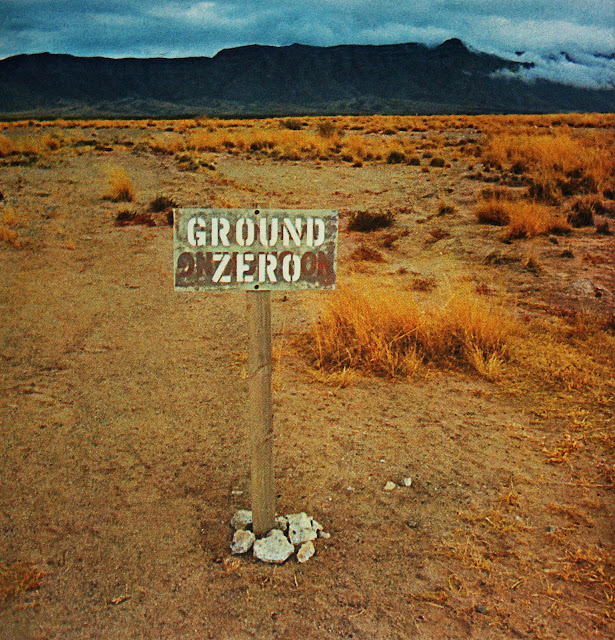
co-opting zero


Co-opting the Anti-Nuclear Movement

by Darwin BondGraham


No medium of propaganda is as powerful and effective as film.  Think of the classics, the most notorious efforts to sway the public with the electrifying and collective passion of cinema: racial apartheid was justified in the US with Birth of a Nation.  The Soviets glorified their revolution with The Battleship Potemkin.  Then there was Triumph of the Will.

A typical propaganda film tugs at emotions and invokes fears.  It invokes dark threats to "the people," and it offers up solutions extolling state and corporate power.  Unlike a political documentary it will not criticize the state or corporations.  Instead it will celebrate great men as our leaders and saviors.  Distinct from a run-of-the-mill political documentary, a propaganda film butchers the complexity and contradictions that permeate politics and real life, presenting things in simplistic moral terms.  Functionally, propaganda is mobilized to secure popular support for a primary, often hidden agenda that is not apparent in the film's narrative.  Propaganda is a tool used by elites to secure the consent of the masses, channeling their anxieties.

Now hitting theaters is one of the most dangerous propaganda films produced in decades.  Countdown to Zero "traces the history of the atomic bomb from its origins to the present state of global affairs."  A promotional blurb on the film's web site claims that it "makes a compelling case for worldwide nuclear disarmament, an issue more topical than ever with the Obama administration working to revive this goal today."

Before I go any further in explaining Countdown as a propaganda film I should note that not all propaganda need be the product of a secretive and manipulative council of elites behind some curtain.  Instead, the many contributors to Countdown and its promotional efforts have different motivations and intentions.  What makes this film a coherent piece of propaganda is its medium, style, and likely effects on the US political climate.  There are powerful actors who will use it for nefarious ends.

On its surface Countdown to Zero is about nuclear disarmament, but deeper down the film is making a very specific case that isn't about disarmament at all.  Its political function will prove to be quite different.  Countdown is joining a suite of political campaigns and other propagandistic efforts, the point of which is to build support for increased US spending on nuclear weapons, as well as a more belligerent foreign policy, based around Islamophobic depictions of "terrorists" and "rogue states."  Countdown is likely to be used by hawks to drum up support for military action against Iran, North Korea, and other states that would dare to transgress the current near-monopoly that a handful of states have on the bomb.