Monday, May 24, 2010

the weak link

[Sorry, this video link is no longer active.]

Stathis Kouvelakis concisely lays out the situation in Greece, the stakes and choices, in the context of a new neoliberal austerity offensive in Europe and beyond.

Additional online resources:

Audio podcast of the panel "Eurozone in Crisis: Reform or Exit?" at Birkbeck, in which Costas Lapavitsas, George Irvin, Costas Douvinas, Stathis Kouvelakis and Alex Callinicos analyze the structural background and political option of exit.

RMF (Research on Money and Finance working group) Report on the Eurozone, in which Costas Lapavitsas and collaborators analyze the EU's center-periphery dynamics and the structural contradictions behind the sovereign debt crisis.

Monday, May 17, 2010

abysmal globalism


Climate, Globe, Capital:
The Science and Politics of the Abyss


by Iain Boal


“At least the war on the environment is going well”
-- North Berkeley bumper sticker 

The brief interlude between 1750 and 1950 AD - the two hundred years between Diderot’s Encyclopédie and the Teller-Ulam thermonuclear weapon – when modernity’s clerisy declared that the future lay wide open under the sign of progress, is now over. Whatever the high functionaries of state or the managers of global trade say at the UN Climate Change Conference in Copenhagen (COP 15), their speeches will be delivered over the corpse of Enlightenment optimism. Ironically, it is the scientists who, after waging a long war against Christian catastrophism in order to establish a deep secular past and by implication an open and contingent future, will be officiating in Denmark as priests of doom. 
 
Not that for those two centuries all talk of apocalypse was confined to the pulpit. Far from it. Even in the rosy dawn of enlightened optimism, reflected in William Godwin’s anarchist utopia – he was of the generation born in the 1750s - a reactionary counter-narrative was being forged in the halls of official knowledge. Thomas Malthus, the world’s first paid economist (in the employ of the East India Company), launched a frontal attack on Godwin’s political science and his vision of an ample world adequate to human needs.

Economics, as defined by Malthus and taken as orthodoxy ever since, is the science of “choice under scarcity”. However, the primary cause of that scarcity - the brutal clearances and enclosures of land that dispossessed the commoners and cut them off from their means of subsistence - was not a topic for polite discussion either in 18th century drawing rooms or in today’s business schools.

Paradoxically, at the same time as it assumed scarcity, the science of economics also assumed infinitude, that is, the bottomlessness of nature as sink and sewer. And for most moderns and all capitalists, until very recently, a reservoir without limits, though patchy and uneven, wherein lay their opportunities and the signs reading “Development”. It is a striking fact that Thomas Huxley, a leading scientist, “Darwin’s bulldog” and no stranger to the role of scarcity, could make this statement, in a paper presented at The Great International Fishery Exhibition in London in 1884: “The cod fishery, the herring fishery, the pilchard fishery, the mackerel fishery, and probably all the great sea-fisheries, are inexhaustible; that is to say that nothing we do seriously affects the number of fish. And any attempt to regulate these fisheries seems consequently...to be useless.”

It is this fundamental contradiction that now threatens the equations of resource economists, not to mention life on earth. Endless growth may linger as an abstract ideal, but capitalism’s material waste – the ‘externalities’ dumped in land, ocean, and atmosphere – is a large turkey coming home. COP15 is the sound it makes.

Friday, May 14, 2010

the struggle at middlesex


The Attack on the Humanities in British Universities: A Report from the Front Line.

By “Joe Jack-Toe”

Over the last couple of weeks, events in the British Higher Education sector have made me think again about the writings of Jean-François Lyotard, in whose work education was an important theme. Dense and abstract though his work is, it returns to me with a renewed and practical significance. Towards the end of his life, in the 1980s (once he had turned away from the earlier positions of, for example, his book on Libidinal Economies, which intimate that the forces of capitalism, in breaking up the old order of things, might in some ways start to allow the forces of the id to speak) Lyotard worried about the effects of the capitalist organisation of society on education, on our intellectual life, and on philosophical thought – and, of course about the effects of such a transformed world of thought on our social life. In The Inhuman and The Differend he envisioned capital as a totalising “monad in expansion,” a system which sought to extend its monological regime of discursive process throughout all spheres of human action, chaining desire, inquiry, and even the forces of anguish within a system of the production of “novelties” which can never amount to the true “event” of a radical break with what is. Such a regime of novelty echoes Benjamin’s vision of the capitalism of the Arcades – always producing new fashions, but only in order to ensure that nothing fundamentally changes. For Lyotard, such a regime, deeply entropic, involves a kind of a flattening of human potential, the death of what real “thought” might be. 


Though it will seem strange to some (especially those who are more familiar with his earlier works, or with the reputation he gained from these) to enlist Lyotard as a philosopher of “critique” in this way, such real thought, for the later Lyotard, was a matter of the agitation of that which cannot be spoken within a particular regime of discourse, the differend, that which fundamentally disagrees with the system, but which returns on it from outside, like the repressed, in the name of a certain freedom and liberation. This, argued Lyotard, was the importance of philosophy, of art and of intellectual work more generally, standing for that which has not yet been homogenised by the systems of capitalism, harnessed to its production of cheap thrills and petty innovations, and to the flattened, repetitive, and numbing spectacle of its realm of (media) representations. Thought – philosophy – was the pulse of a freedom which stood out against this realm, and which opened up the possibility of something else. The institutions of education and academic life were a vital part of what fosters such thought.

Lyotard thus bemoaned what he saw as the erosion of such a freedom of thought under the pressures of the marketisation of intellectual life. Since his death those pressures have only multiplied. He noticed the pressure, for example, on academics to continually publish in order to have their research quantified and graded by the state in order to ensure the continued influx of research funds, and noted that this leads to an impoverishment of thought where “novel” and publishable ideas are churned out rapidly, yoking thinkers to a mode of time usage which does not allow the space for properly new, radical or substantial ideas to develop. In this, he saw academia becoming a machine for churning out books and papers, and for keeping the funds flowing through Universities and publishing houses, rather than a means to think through issues of deep import. In the UK, Lyotard’s observations have been prophetic in terms of the unfolding implementation, since he wrote, of the “RAEs” (Research Assessment Exercises) which have been running periodically to assess, measure and then reward or punish Univeristy departments’ research outputs.

The discussions of education and philosophy in Lyotard’s late texts thus have a continued, and even increased significance for us today, where the logic of neoliberalism has only intensified under the regime of globalised capital, in spite of ostensibly “left-of-centre” governments such as that of the “New Labour” party which replaced the Conservatives in Britain in the 1990s. Under New Labour, and under the logic of marketisation, quite aside from the submission of research to quantifiable outcomes, the government has abolished student grants and introduced tuition fees. Universities have increasingly been asked to run as businesses rather than as public institutions, and, worse than this, such marketised education has increasingly been the object of manipulation through the ideologised manipulation by governments of the parameters within such a market is to function.


The questions of the nature of thought and education in the capitalist milieu comes back to me particularly strongly, however, in the light of current events in British education, and in particular within the University in which I work, Middlesex University. Readers of scurvy tunes may well be aware (to some extent at least) of the current controversy which has sprung up at Middlesex. On the 26th April, the University announced its perplexing decision to close its Philosophy department, a decision which shocked both staff at the University and the international philosophical community. The philosophy department at Middlesex can hardly, it would seem, be thought of as a failing department. In the recent RAE it was the department in Middlesex with the highest-rated score, and one of the top Philosophy departments in the country. Middlesex was formed in the 1970s first as a “polytechnic” institution (the Polytechnics in England were primarily vocational colleges and though they offered degrees did not have the prestige of a “University” education proper) and only in 1992 obtained the status of a University, so does not have many departments with serious academic research credentials, and Philosophy is the one beacon of real excellence which the University has. Its academics (Peter Osborne, Peter Hallward, Eric Alliez, Stella Sandford and Christian Kerslake, for example) have truly international profiles and their Centre for Research in Modern European Philosophy – along with the journal Radical Philosophy which is largely produced at Middlesex – is probably the most important centre of “continental” (non-analytic) philosophy not only in Britain but in the English language. The CRMEP is also a key hub within the intellectual life of the humanities in London, with frequent and high-profile events bringing important scholars from around the world into the city. Philosophy at Middlesex has one of the largest Philosophy MA programmes in the UK and a healthy turn-through of PhD students (in fact, more PhD students complete with the Philosophy staff than the rest of Middlesex’s School of Arts and Education combined).

The closure has caused widespread protest, both within the university and also beyond it. The students on the course have occupied one of the buildings on the Trent Park campus and set up a Facebook site(now with over 11,000 members), a petition (with close on 15,000 signatures) and a campaign website. Staff in the University bombarded the School’s Dean, Ed Esche, with emails. Statements of support have come in from international intellectuals of the highest stature, such as, for example, Alain Badiou, Noam Chomsky, Slavoj Zizek, Judith Butler, and Michael Hardt. They also came from faculties across the UK and beyond, from the American Philosophical Association Executive Committee, the British Philosophical Association, and many, many other individuals and groups. Talks have been organised by the occupying students on campus, with speakers such as Tariq Ali (Sat 15th May) and Tony Benn coming up. A conference will be held at Goldsmiths, co-organised with the ICA, entitled, “Who’s Afraid of Philosophy?” on 19th May.

So why has the University decided to close this seemingly thriving department? The reply, to Philosophy staff, was that the department made no “measurable” contribution to the University. They stated, rather bizarrely, that courses at Middlesex are expected to contribute 55% of their income (beyond what they spend directly on their students) back to the centre of the University, whilst Philosophy in the coming year would only be able to contribute 53% – a shortfall of a whole 2%! Lyotard’s nightmare of what happens to thought (and education) when it is yoked to the logic of capital here is taken to its most perverse extreme.

Monday, May 10, 2010

imprint


I started this “blog” in February 2010, after a visit to my native country – a short skip back behind the walls of Homeland Security. The face of the regime had certainly changed, but the course remains distressing. The scurvy tunes, written “through the estranged and alien optic of exile,” launched the bad notes of my distress.

Around the discordant rantings of a mask named Jehan Alonzo, I played, posting polemical ripostes and a plunder of images. In the days of Millennium Challenge and America’s Army (the Pentagon war gaming exercise and US Army’s wildly successful online “multiplayer first-person shooter,” respectively), even the subversive refuge of “serious play” can be made to generate weaponized toys for domination.

Nevertheless, my ludic mischief gave me short relief, and so I persisted. Flares, stains, ciphers, signals and tunes stacked up. From these critical and parodic figurations sobering constellations emerged. At least seven of them, circling, probing:

    the deeper meanings and legacies of Hiroshima;

    the enforcement functions of state terror since 1945;

    the dirty “war on terror” and the problems of enjoyment;

    tea partiers and American pseudo-democracy;

    the stalled project of revolution;

    the politics and blocked promise of art;

    the liberation of nature and the difficult outlines of freedom and necessity.

Those familiar with my work will recognize the problems that have concerned me for years. Playing through the disturbances of re-encountered homeland, I returned to my pack of obsessions.

And as I grappled with them yet again, the site seemed to grow on its own, tracing a reflection that edged along in several directions, archiving a process of thinking in and through images, as well as concepts and the playful stuff of language. Across posts, critical propositions and running analyses have begun to link up into sustained arguments. Along the way, some political positions were marked out and elaborated.

On this foundation, I now want to open up the project to a more collective and polyphonic participation. Let the positions so far registered be taken as editorial stance. Let the constellations indicated serve as topical problematics. All else is open. I now invite, and will solicit, contributions from friends and comrades, and their extended networks.

(I’ll continue to toy with JA, since his voice and imposture amuse me. But hereafter I’ll initial my texts, hoping thereby to reassure friends who feared I’d gone off strangely.)

Be invited then, to help me shift this thing in the direction of an online magazine – a critical commune relentlessly aimed at the given, and thinking beyond it in a spirit inclusive of serious play. It won’t be artful all the time, but neither will it count for tenure. Let these stay processural notings, given freely – short-form essays broadcast in defiance of proprietary hoarding of ideas. If the experiment fails, so be it. The struggle continues, if not by this wager, then by others.

Gene Ray (GR)

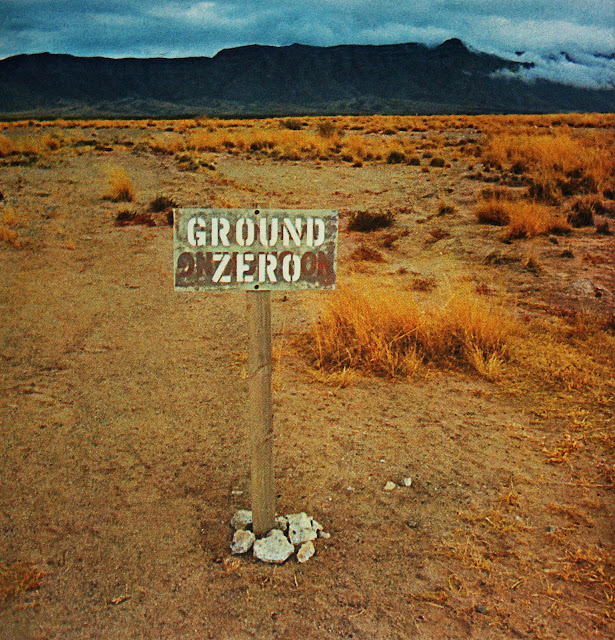
On the images: The homepage image is the originary ground zero, north of Alamogordo, New Mexico – in a barren stretch of desert the Spanish named La Jornada del Muerto, the “Journey of Death.” There, on 16 July 1945, the scientists, techno-administrators, brass and grunts of the top-secret Manhattan Project came down from Los Alamos to detonate the Trinity test shot, the first atomic explosion. The terror bombing of Hiroshima and Nagasaki followed with all haste, just as quickly as technically possible. The photo, taken by Elliott Erwitt, shows the site as it appeared in January 1965.

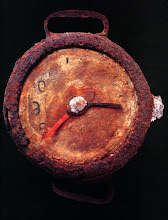
JA’s visage qua avatar is Seiji Fukasawa’s photo of a wristwatch pulled from the rubble of Hiroshima. Its hands, arrested by the blast, tell mutely of a passage to a new time of terror. The still unfolding meanings of that moment, both stoppage and threshold to a new mode of enforcement, are a mirror to the concept of humanity and its ruined myth of progress. In that mirror, every face is unhappily reflected and politics takes on the urgency it has never, since then, for one second relinquished or relaxed, whatever collective denials, disavowals and twisted rationalizations obscure it. In the threatened terminations of that catastrophic demonstration, however, there still pulses a latent political imperative: in ways yet to be actualized, that blasted moment of terror promises to make humans and abolitionists of us all.

Thursday, May 6, 2010

another default is possible


The general strike and demonstrations protesting the misery plan masquerading as “bail-out” yesterday were massive and robust. The several hundred thousand who impressively filled the streets and Syntagma Square are constituting a political force that today is the real locus of democracy in Greece. 

Protests like these helped to bring down the dictators in the early 1970s and more of them now can topple a pseudo-democracy that has failed the country. As PASOK leads the IMF Trojan horse through the gate of Parliament, the unions and groups are gathering for renewed protests this evening.

There are many possible resolutions to this crisis. By no means is the official immiseration plan a “done deal,” as the capitalist media now acknowledges. Even the Wall Street Journal recognizes that default could follow from determined resistance.

Greece faces hard times, but who will have to bear the brunt of the pain? This is a political question that will be decided by the struggle now unfolding.

Who should pay? Whose dignity is to be sacrificed? Why should the banks and creditors, the politicians and major tax-evaders escape the plight they have dumped on the country through corruption, negligence and opportunism?

These are questions of justice and community, and the usual glib mix of lies, platitudes and neoliberal clichés is not going to satisfy a people awakened and stirred.


A real political moment has been opened in Greece.

Default would mean renegotiating everything. But who can be trusted to negotiate for Greece? Certainly not PASOK or New Democracy.

So it’s also time to question the form of democracy, and, if necessary, to change it. Not just the ruling government, then, but government as such is at issue.

Whatever Greece gained under the sign of Europe now comes at the price of immiseration, and there are no guarantees that ostensible benefits will survive the bailout – as any honest analyst admits.

If the Euro founders and the project of “Europe” breaks up, as Merkel in Berlin is whining, then junk this neoliberal, technocratic Europe and let’s see what real democracy can put in its place from below.

These are days for solidarity and focus.


In the fog and tear gas of struggle, we hope comrades will act with all possible care and compassion. We understand the rage and frustration, and the economic terrorism behind it. And we can see the everyday context of state repression and provocation, falling hardest on immigrants and autonomist young people.


The deaths of three employees at Marfin bank is a shock that hits us, too. The loss of three lives is terrible, and a real disaster for their families and loved ones. While we doubt this was intended by any comrade, we’ll also refrain from shifting all blame onto the bank’s chairman, who insisted with threats that his employees stay at their desks on the path of a massive and angry protest. The bank’s negligence was in any case well summarized by an employee, in a letter that has circulated widely.

There is, always, an ethics of struggle, and we hope there will be searching reflections and discussions of appropriate tactics and strategy in this one. We also hope solidarity and realism will keep those debates, when they happen, from becoming divisive.

As far as we can see, this is above all a struggle for dignity and the meaning of democracy. Dignity and real democracy are worthy aims that are not beyond reach in Greece. In the context of Europe, no struggle now is more important, and the hype and spin of mediatized wedges driven from above should not be allowed to distract or divide it.

AP/GR 


Letter from a Marfin Bank employee, in Greek original on Indymedia Athens and translated on Occupied London.

Sunday, May 2, 2010

watching greece


Watching, observing from abroad – these “posts” issue from the wordy distance of this position and have often underscored it – one is staggered by the crudity of European hypocrisy regarding Greece.

Greece: one in five Greeks already lives below the poverty line, and yet the Greeks as a whole work more and longer than their European neighbors, the fabled Germans included. Now these same people are routinely and thoughtlessly blamed for their collapsing economy – their plight attributed to, among other chauvinist clichés, a purely fictional laziness undeserving of European “rescue.”

What garbage! This national economy was ruined not by “the Greeks” – the men and women who live and work there – but by the corrupt political class that administrates it and the tax-evading Greek ruling class that, along with the raiders of international capital, have plundered it for decades.

In this tired trope of “blame the victim,” we should be scandalized by the two extra months per year that public sector workers earn, thanks to the struggles of their unions, etcetera, etcetera.

To save the Euro, if this grace in the end is extended, those lazy Greeks will have to break their unions and lower the cost of their labor-power – and should be grateful to their masters and administrators for the opportunity to do so. Tame and demoralize those working people! Austerity, and more of it, quickly!! 


Hearing and reading what, obviously and crudely, is being said and written between the lines, addressed to, directed at, “the Greeks” and their “self-made crisis,” by the amplified voices of “Europe,” by the very voice of arrogant administration, of managers, custodians and mouthpieces of exploitation, the neoliberal technocracy that deems itself qualified to issue directives from above and is shocked if obedience does not immediately follow – hearing and reading and watching, one knows whose side to take.

But where is the international solidarity with the Greek men and women on whom a fraudulent austerity is being foisted and forced, as if it were natural necessity?

What to say, what can be said, by an outsider, observing? I admire and am inspired by Greek resistance, by this determined, visible refusal to accept administered fiat. Too bad others elsewhere don’t follow their example; if more of us did, the rule of pseudo-democracy could begin to open up and change.

There is evidently no solution for Greece within the constraining logic of the EU and Euro, other than the neocolonial dependency of the IMF debtors prison. Such is the global power of capital, against which other logics are necessary.

It’s for the Greeks and no one else to decide if this “Europe” is worth the misery that is its price – or whether, relying on their own impressive inventive resources, they might not instead rethink and reorganize the bases of their collective autonomy. For the others, for the rest of us, isn’t it time to remake “Europe” and everything else, from below?

Another general strike and day of protest has been called for May 5...

Here's the EU’s own statistics on working hours and work intensification in Greece.

Saturday, May 1, 2010

on enjoyment and enforcement


In the police states of “actually existing socialism,” security agencies infamously kept files on everyone, cradle to grave. Blackmail and banal corruption were systematically insinuated into everyday life by the state, in order to produce informers – compromised, pliable individuals caught in webs of dependency, suspicion and impotence. A particular form of prohibitive control: a specific social relation and its corresponding subjectivity.

In contemporary capitalism (Todd McGowan, Yannis Stavrakakis and others propose), such old-school prohibition societies have been transformed into societies of “commanded enjoyment.” Enjoy! is the new directive. Discover and express yourself, by freely spending your money! No money? No problem, buy on credit! This command seems to reverse the basic bourgeois values of personal self-discipline, of saving and delayed satisfaction, of not spending what you don't have.

But in fact, even in economies of relaxed credit, the imperatives of lifelong commodity consumption – of the restless exploration of identity through the purchase of products and the auratic fantasies that surround them – demand the internalization of work discipline and all the integrations it implies. Overall, avid consumers have to work longer to earn more, and the crisis that reasserts this rule only proves it. (Think Greece, right now.)

Accommodation and resignation are thus the price of interpellation into the commodity world. To enjoy what feels like freedom, we structure obligatory social constraints on the inside of our subjectivity, as the new forms of dependency, discipline and limit. It works, because our commodity fantasies do deliver a partial enjoyment that keeps us seeking and buying, and therefore accommodated. The given doesn’t give all it promises, but it apparently gives more than anything else on offer.

Yes, enjoyment seems to be one key to our social reality. But, as this singer of scurvy tunes keeps insisting, enforcement is its necessary shadow: state terror takes new forms today. Moreover, these forms are vastly more powerful than the crude forms of old.

Online social networking suffices to make the point. Through the games of self-display played on Facebook and blogs (this one not excluded), we compile archives that are probably more revealing than the Stasi files of the East German police state. We enthusiastically publish our desires and fantasies, in words and images that always say more than we intend.

We hardly think about this organized indiscretion, this voluntary abandonment of inhibitions, which we moreover perform for free. But in fact, our habitual self-exhibitions and our interactions with other self-exhibitors silently accumulate in digital form, on distant servers we are hardly aware of.

There, they merge with the other accumulated traces of our movements and purchases, now become objects of data miners and hackers, actual and potential. In the first instance, of course, we are induced to profile ourselves for the attentions of marketers. But the state – and let’s not forget that the Internet originated as a project of the US Department of Defense – has access to all of it, as the “war on terror” has taught us.

So, yes, enjoy! And in so doing, archive your history, memory, and fantasy life. It’s fun! This is the carrot of late capitalist governmentality and industrialized virtual culture, and Lacan and Foucault, as well as Adorno, can help us to grasp it.

But don’t forget the stick! Powers of terror and enforcement have not withdrawn from the scene – they have expanded in unprecedented and qualitative ways. In the nuclear global regime of national security-surveillance states, techno-power overwhelms politics and ethics through the fatal knotting of war machine, science and state.

For enjoyment and enforcement go together. Integration and administration are increasingly internalized into the forms and structures of contemporary subjectivity: by enjoying in the approved ways, we largely police ourselves.

But no system attains the totalization it aims for. At all the points where the repressed returns, where the real exposes the failure of systematic enjoyment to deliver what it promises, rebellious subjectivities and uprisings incessantly break out.


We’ve already imagined, in film and fiction, where these developments tend: our self-compiled archives will be linked to terminator robotics. Nano killer-drones will be dispatched to eliminate subjects in revolt – eventually, for this is the immanent logic of exceptional security, preemptively.

If we know this, and keep mouse-clicking anyway, is this form of disavowal an aspect of our enjoyment? Probably. The forms of our sociability expose us, and silence doesn’t get us out of this circle.

Enforcement, at bottom, is necessary because the current system of enjoyment is antagonistic in specific and unsustainable ways: socially and ecologically, the limits of capital accumulation loom.

The radical response, faithful to “what is still now and then called humanity,” is to politicize these erotics.
Friday, April 16, 2010

terror and nuclear politics


But wait, you’re always going on about nukes, and now Obama has made a commitment to reduce them, but you’re still complaining!

Any reductions of nuclear arsenals are welcome, that goes without saying. The problem is rather in what is not said and not done, what is done instead – what’s really going on by means of such “small steps” is the continuing refusal of the decisive and radical step of nuclear abolition.

In the case of certain problems, the strategy of small steps is an evasion. Any reduction of carbon emissions is also, on the face of it, a good thing. But reductions that are far below the rate needed to prevent catastrophic climate change are inadequate and cynical, since they deliberately avoid the essential problem. In that sense, they are politically bogus: they give us the false comfort and security that things are being done, that our smart masters are on it, taking steps in the right direction. Thus our protests and demands for change are emptied of urgency, rendered superfluous.

Moreover, carbon trading schemes reveal what’s behind this fraudulent refusal to change the status quo of unquestioned growth: the market invents ways to capitalize on the fear and real threat of global warming. Misery rendered profitable, disaster capitalism. 


As a technic of terror and genocide, nuclear WMDs have to be refused decisively and absolutely. In this they are like the historical problem of slavery: the liberation of any individual slave is to be celebrated, but only the radical move of abolishing slavery in toto, as an institutionalized social relation, is an adequate political solution.

In Obama’s nuclear posturing (the treaty with Russia in combination with the Washington summit), we have to recognize what he declines to do, refuses to refuse: instead of cutting the knot and pushing for abolition and a secure process of disarmamant (the real conditions for the “nuclear-free world” once lip-served), he opts to manage the status quo. He tries to preserve all existing power relations and asymmetries: a reduction of warheads, but business as usual.

Instead of a clear renunciation of the doctrine of nuclear first strike, he gives us a lawyer’s re-definiton that threatens Iran and North Korea (as signers of the NPT) with a first strike, while Israel (as a non-signer with an arsenal of some 200 nukes) gets yet another pass on its state of exception.

This confirms what Susan Watkins recently concluded in New Left Review: “The role of the [Nuclear Non-Proliferation] Treaty is to insure the nuclear privileges of the haves against the have-nots.” For NPT, read “Non-Protestation Treaty.”

The NPT is one process, among others, aiming to “lull protestation” and bring rebellious states to heel – meaning make them submit to the global order of managed imperialist rivalry, IMF and debtors prison. "Play by the rules" means the rules we dictate.


With regard to nuclear terror, the only real (as opposed to pseudo-) solution is to abolish this category of WMD without exception, a political goal that only the US could convincingly undertake to lead. In contrast, the nuclear club’s retention of member privileges against the excluded is the maintenance of a system of domination – the continuation of global class war by whatever means.

The reality, yet to be faced in political debates, is that the terror and anxiety generated by nuclear arsenals has specific enforcement functions: this terminal genocidal power of state violence, demonstrated on the civilians of Hiroshima and Nagasaki and by numerous tests in the decades following, is an ultimate deterrent to any substantive change in the given relations of domination. “If you push us too far, and really threaten our power, well, then...”

Moreover, these enforcement functions have transformed processes of "governance" in ways that further constrain and block movements for real democracy and change. These scurvy posts have often pointed to the historical mutations in the US state, which carry special weight given the role of the US war machine in enforcing the global order and insuring that changes develop along certain lines rather than others.

Let’s sum up these mutations: The security and command imperatives of the bomb, in combination with new sectors of profit, transformed a constitutional democracy (imperio-capitalist) into a pseudo-democratic national security regime (imperio-capitalist). The bomb, exerting its own needs and logics over the state as a constant pressure, generated powerful tendencies toward secrecy and increasing concentrations of executive power.

Since 1945 these tendencies transformed the constitutional balance among branches of government, creating a de facto extra-constitutional regime in which exceptional executive privileges and encroachments became normalized. This opened the way, in the Cold War conjuncture, to massive expansions of covert programs, with all the associated opportunities for abuses.

In this light, the restrictions temporarily placed on President and CIA (the prohibition on assassinations, for example) following revelations in the wake of Watergate were a brief pause, a momentary counter-tendency to bomb-generated pressures. The Reagan presidency and Iran-Contra represented the reassertion of these dominant tendencies within the US state. The Bush-Cheney neo-con regime confirmed the overall push toward increasing secrecy, surveillance and executive power, and the Obama administration now confirms its bipartisan character 


A major shift in the strategic logic of the bomb following the end of Cold War bipolarity has not greatly altered or derailed this trajectory of the US national security state initiated in 1945. Many things have changed, but this hasn't. The so-called war on terror provides the needed justifications to continue the normalization of exception, permanent state of emergency, and deepening merger of war machine, science and entertainment industry.

Thirty years ago, E.P. Thompson warned us that nuclear weapons have to be grasped not as things but as social processes. Since those important debates, this problem keeps slipping from conscious attention. While much more critical work in this direction needs to be done, it’s clear that WMDs function as factors of terror within a much vaster system of social control.

To challenge the war machine at the enforcing nexus of this system is to challenge the global rule of capital. These tendencies are far more powerful than any individual politician, and the interests entrenched therein have repeatedly shown their willingness to defend their power and privilege by all means.

Obama, alone, could not have challenged these tendencies and the power they have produced. At most, he could have moved strongly to place the real problem on the agenda for genuine public debate. He did not, but without pressure from below, why should he do so, to his own risk? (There's a dialectic here, and we are naive if we wait for an invitation from power to pay attention, speak out and organize our demands into political force.)

Only states are capable of making and deploying nuclear weapons. These are beyond the means of militant groups and networks, and claims otherwise, whoever makes them, are a lie intending to terrorize. Such is the politics of fear, and Obama has accepted its terms and obligations.

A world in which states are not permitted to make and accumulate WMDs would be a more democratic and transparent world – one of radically increased possibilities for reorganizing social relations.

But a world without WMDs would have to be struggled for, from below and outside, as well as inside the state, with patience, realism and radical aim. But only thus will the rule of terror be broken; it won't be a gift from above. Evading these realities does not escape their power; the repressed returns, and all movements of emancipation will sooner or later have to face this one.

Ecological sanity and the liberation of nature, the master logic of capital accumulation, the global enforcement regime and its fantasy forms of enjoyment: all these belong to a single problematic. They are inseparable; each opens up on the other.

  
Susan Watkins, "The Nuclear non-Protestation Treaty, NLR 54 (Nov/Dec 2008).
Edward Thompson, "Notes on Exterminism, the Last Stage of Civilization" NLR I/121 (May/June 1980)
Raymond Williams, "The Politics of Nuclear Disarmament," NLR I/124 (Nov/Dec 1980)

Thursday, April 15, 2010

war machine spending


One more time, the glaring contradiction in the tea party: this anti-state, anti-tax agitation is at the same time militarist fan-club of the imperialist war machine.

Let’s see how much of a contradiction this is, for it also exposes the real social problem, one of the main threads of these posts.

In Washington the proposed 2011 budget is on the table. A tally put up on Counterpunch reckons that, leaving out Social Security (which returns to citizens money they’ve already paid into a dedicated fund), it will add up to about $3 trillion.

Of that, military spending will account for about $1.5 trillion – shockingly, a full half of real public spending, broken down thus:
    Pentagon spending                       $708 billion
    Extra allotment for overseas wars       $200 billion
    Surveillance and spy agency spending    $ 40 billion
    Other non-Pentagon military spending    $ 94 billion
    Interest on debts for wars              $400 billion
   
(I’ve left out veterans’ benefits and health costs, which no one should object to but add up to another $100 billion.)

Dave Lindorff comments: “The 2011 military budget is the largest in history, not just in actual dollars, but in inflation-adjusted dollars, exceeding even the spending in World War II, when the nation was on an all-out war footing.”

And this budget for the US state’s war machine, ostensibly "defending" 5% of the world’s population against the other 95%, will account, as it has for years, for about half of all global military spending.

So that's the picture, behind all the distracting garbage, there it is: permanent war, but no money for health care, education and culture, public transportation and basic services. Decided de facto: war machine rather than all that reduces misery and makes life better and more humane.

The spectacle of politics in the US remains a lethally childish cartoon until this reality is confronted.

The contradiction around which the tea party marches exposes that manipulated movement for what it is: a lynching machine aiming to lever Republicans back into power.

The larger contradiction, operating globally, continues to kill. It points to the real social function of the US war machine, which enforces not just US dominance but a whole system of rivalry-within-dominance, the rule of antagonism, a planetary order of exploitation and oppression.

Call that into question and you call everything into question. 
on tea partiers

Dave Lindorff, “Where Your Taxes Go,” Counterpunch, 13 April 2010.
Running tally of the costs of the wars from National Priorities Project.

Friday, April 9, 2010

end this


Theodore A. Harris. End this War...(after Shirley Chisholm), 2008.

The imbrication of race, war and capital, perennial recruitments and occupations, perennial sacrifice of colonized minds and bodies. Dead center, tattooed on eagled seal of empire: the face of what is. Promises routinely deferred, dignities routinely shot down. And getting up, again, in resilience, because these are struggles, resurgent, in the embodied fist of no.

war porn (2): interpellation


An everyday massacre, the obscene reality of occupation.

In New Baghdad on the twelfth of July 2007, death rained down from the 30mm cannons of two Apache gunships. (And let us not miss the history of blood and original accumulation condensed in that linguistic expropriation: a name stolen from a people who symbolize indigenous resistance is now the trophy-scalp decorating a flying weapons platform of US Army Air Cavalry, successors of the horseback troopers who chased Geronimo.)

The problem of enjoyment – of “war porn” – in this video released through WikiLeaks is glaring: the images of a dozen people slaughtered from the air do not in themselves exclude fantasmatic identifications with the voices heard and, through them, with the power of these weapons and the war machine as such. Similar images, seen countless times in the entertaining fodder of the cinema of war, erode the power to hold apart fiction and real killing.

There is a habitual structure of projective identification activated here that holds out something like a spectatorial path of least resistance. It tends to suck us in and place us, so that we assume a certain position and point of view in the antagonistic scenario. And this of course is exactly how movies and video games work. The template of entertainment matches the actual massacre.

Watching this video aligns us, like it or not, with the occupier's gaze, the soldiers' gunsights - behind which, the god's eye vantage of fantasmatic power. (The cameras of the murdered journalists would give us a very different vantage and image: see the negative presentation below.)

The fantasy of omnipotence is of course only a fantasy: the murderous paranoia of the soldiers, seeing weapons and enemies everywhere, betrays this clearly. Such paranoia is structurally produced by the occupation itself: they are manifesting the survival imperatives of occupiers (which does damage to them as well). But the ethical lapse this entails is mirrored and encouraged by the structure and template of the video image. The fantasy of absolute power that activates these alignments sets up the possible enjoyment for spectators.

Even if - consciously, ethically, politically - we refuse with a fitting revulsion the point of view offered, the fantasy lure of power never ceases to call to us in ways we can't be certain we don't respond to unconsciously. Enjoyment, in this sense, doesn't exclude the displeasure of revulsion.

Ethical corruption and the attrition of outrage thus accompany such images, along with disgust and indignation. We're obligated to see and absorb this video, in order to witness what's being done. At the same time, we need to resist and palpate its insidious lures. Here as everywhere else, we have to struggle for our humanity.

WikiLeaks has undertaken with courage and diligence the tasks of decrypting exposure abandoned by a mainstream journalism castrated by its corporate owners. For that, it is under attack by numerous states and agencies, including the Pentagon – as even the New York Times acknowledged on 17 March.

In the struggles to resist neo-imperialism, the info wars remain a crucial battleground. Under conditions of integrated spectacle and stupefying concentrations of corporate power, access to truth and counter-images is fundamental. And we’re going to have to fight for it, as the blow US courts struck this week to the principle of net neutrality should alert us.


Photo is from Gardez, Afghanistan, on the wake of the 12 February killing of five people, including two pregnant women, by US Special Forces.

Glenn Greenwald reports on the campaign against WikiLeaks, the growing fury over the posted video of the 2007 massacre, and the politics of net neutrality in a series of articles for salon.com.

On Democracy Now! Amy Goodman goes over the video with WikiLeaks editor Julian Assange. Families of the victims respond.


A more rigorous analysis of the video in context with Assange on Al Jazeera, 19 April.

five years since

A counter-image from kennardphillipps

The circle of enforcement, circa 2005 (Geneagles G8): our masters’ proxies at table, pentagon embedded, with a hooded trophy. Flags, lies and a magic carpet riding the rim of night, the deciders, criminals all. Who will be targeted, rendered, rent, who will live and who will die? They make a hole, and call it democracy.

Sunday, March 14, 2010

war porn (1): joysticks


When quantity passes into quality, the whole situational context is altered and a new situation emerges.

As demonstrations of new powers of genocidal violence and state terror, Auschwitz and Hiroshima were qualitative leaps of this kind. These new social facts entered history, objectively changing everything.

The scale of the Nazi genocide, meticulously planned and accounted for behind a veil of Nacht und Nebel, was only retrospectively exposed.

The vast Manhattan Project that developed the first nuclear weapons on secret presidential order was kept from the American public until the weapons were actually used; Truman triumphantly announced the atomic bombing of Hiroshima as a fait accompli.

Today, right now, we are living through another qualitative leap in the power of terror and death. But unlike these precedents, this leap has just begun and can still be stopped.

This one, if it is not stopped, will likely be the real legacy of the dirty so-called war on terror.

Without shame or apologies, Obama of the Nobel Peace Prize is presiding over a rapid escalation in the force of unmanned drones used by the US military and CIA for surveillance and assassination in Afghanistan, Iraq, Pakistan and Yemen.

Introduced by Bush II in tiny numbers, there are now an estimated 7000 drones in operation – and the number is rising fast.


Bomb and missile-carrying drones such as the MQ-1 Predator (cost: $20 million per system) and MQ-9 Reaper ($53 million each) are flown by “joysticks” from air-conditioned rooms in Langley, Virginia, and Creech Air Force Base north of Las Vegas. “War porn,” the troops call it.


 A small number of defense contractors, including Boeing subsidiary Insitu and General Atomics, will split the $3.5 billion allotted for drones in the 2010 budget.

To assassinate Taliban leader Baitullah Mehsud on 5 August 2009, it took the CIA sixteen drone attempts over fifteen months, killing between 207 and 321 people in the process. How many were civilians? “Disputed,” but the war wagers are sure it’s worth it.

Evidently, so are Israel, Germany and the UK, all of which fly their own fleet of combat drones. Every state that can, obviously, will follow.


Is Finnegan awake? No paranoia needed, to read the writing on this screen.


Already in development: insect-size “nano” drones, which, The New Yorker reports, “can fly after their prey like a killer bee through an open window.”

Reflect on that, in the glare of the last decade. Reflect on the leap in objective power the state gains by this. Reflect on the state of “democracy” and the rule of exception. Can anyone doubt this will alter social reality and the possibilities for a future?

For now, it takes the appearance-form of assassination power (always with “collateral” killing) – but this obviously does not exhaust potential applications. (And again: where is the outrage and debate over this policy of assassination? Is it now already normalized?)

Reality: killer robotics will expand and combine with qualitative increases in powers of surveillance (think: merger of Google with the NSA) unless massive public outcry and determined protest prevent it.

For the moment, there’s still time to organize it.


Sources:
“Drones Are Lynchpin of Obama’s War on Terror,” dossier by Spiegel Online, 12 Mar 2010.

Interview with P.W. Singer (author of Wired for War), Democracy Now, 6 Feb 2009.

Jane Mayer, “The Predator War,” The New Yorker, 26 Oct 2009

general strike


In Greece on 11 March, hundreds of thousands of workers responded to Parliament’s passage of austerity measures with a 24-hour general strike – the third in a month – bringing airports and public transportation to a standstill.

The strike was called by the main unions, the GSEE and the public-sector ADEDY, which together represent half of Greece’s five million wage-workers.

In Athens and Thessaloniki, tens of thousands protested in union-organized demos.

In Athens as Parliament passed the austerity package on 5 March, employees of the National Printing House occupied and shut down the government presses in an attempt to block the measures from becoming law. (In order to become law, they must be formally published. The government ignored this law, of course.)

ADEDY has called for another general strike on 16 March.

Thursday, March 11, 2010

genealogy of the current regime


“Le fer brûlé. Le fer brisé, le fer devenu vulnérable comme la chair.”
Marguerite Duras, Hiroshima mon amour, 1959/60

[Iron, material of vaunting structures, symbols of progress from an age of optimism. Ironies of history "made vulnerable as flesh."]

“On August 6, 1945 a New Age began: the age in which at any given moment we have the power to transform any given place on our planet, and even our planet itself, into a Hiroshima. On that day we became, at least modo negativo, omnipotent; but since, on the other hand, we can be wiped out at any given moment, we also became totally impotent. However long this age may last, even if it should last forever, it is the “Last Age”: for there is no possibility that its differentia specifica, the possibility of our self-extinction, can ever end – but by the end itself.”
Günther Anders, “Theses for the Atomic Age,” 1959

Collective denials and evasions still in force, blocking, freezing, blinding. Who wants to know, who has time to know, who has the luxury and attention needed to know – and what would anyone do with such knowledge anyway?

Hiroshima: regrettable necessity of the “Good War” against fascism? That lie was long ago exposed, but the exposure still goes unregistered in the place where it counts.

To think and grasp: the global imperialist context 1914-1945 as a single social process (WWI, Russian Revolution, rising US power, defeat of revolution in Germany, fascism in Italy, crisis and Depression, Stalinism, Nazism, crushing of Spanish Republic, WW2, Auschwitz, Hiroshima).

If Auschwitz and Hiroshima cannot be separated from the global process and master logic of capitalist modernity, as it actually unfolded, then what emerges as decisive is the course of class struggle over those three decades. Above all: the defeat of revolution in the capitalist core (Germany, Italy, Hungary) transforms the Russian Revolution into the state capitalism of “socialism in one country,” setting the stage for both Stalinism and Nazism.

Not to say it could not have happened otherwise. Not to deny that this historical period is complex and contradictory. But to acknowledge and to insist on the pressure of the master logic, behind and in the specific processes of Auschwitz and Hiroshima.

This is what the linkage of Auschwitz and Hiroshima, still so controversial, still so resisted, expresses: not that these event-processes are identical or equivalent, but that they must be grasped and thought together, across their obvious differences. What this “and” says is that both are specific appearance-forms of a single social essence.

And that they in turn transform the way in which this essence will from then on unfold: changing the form of the capitalist state, initiating the normalization of exception. The post-1945, post-Auschwitz, post-Hiroshima global regime: our social reality.

“Crucially, these genocidal techno-administrative forces were developed in a specific global conjuncture of class struggle: they are products of defeats suffered by the exploited and from now on are aimed at the exploited, as the weapons of state terror. That is, they are aimed at humanity itself, at the potential humanity carries in itself to overcome its fears and collective self-oppressions and make the social passage from necessity to freedom.”

which terror trumps?


State terror: terminal powers of enforcement.

Auschwitz: objective demonstration of a new state power, administrative-industrial genocide.

Hiroshima: objective demonstration of another new state power, the Weapon of Mass Destruction that self-justifies the merger of science and war machine.

Political necessity of the new regime of exception: an absolute enemy, someone, somewhere, preferably a dark bearded face, an imago to be targeted with trembling and enjoyment, the terminating focus of all displacements in the politics of fear.

This is how the capitalist process reproduces and enforces its own conditions today. And new techno-powers now emerging may also prove qualitative: killer drones and terminator robotics combining with god’s eye satellite and internet surveillance.

Through the chains of mediation – administration, integration, culture industry, spectacle, biopower, “war on terror” – state terror points back to the valorization-accumulation process driving our commodity world, the master logic of capitalist modernity.

But now a new factor points more immediately to the same master logic: collapsing ecologies, degradation and depletion, species extinction and climate change.

In the form of looming planetary meltdown, the capital accumulation process itself becomes directly genocidal.

The more the economies grow, the warmer it gets perforce, sentencing more to misery and death, bringing us all closer to critical tipping point. But in a capitalist world, economies that don’t grow also mean unemployment, misery and death: neo-imperialist war machine.

The alternative to this viciously self-terminating “progress”: global reorganization, collective passage to non-domination, a sustainable social logic.

Formerly, in Marxist vision, this passage was the leap to freedom. Today, the urgency with which it begins to bear down makes it appear rather on the side of constraint: the rational self-constraint now demanded by the same instinct for self-preservation that long ago reversed into its irrational opposite.

Benjamin: revolution as the emergency brake on a runaway train.

The actual problem we face: how to organize the reorganization in a non-catastrophic way.

Eros, the liberation of nature, passes through the passage to classless society, but does not end there.

Ecological meltdown begins by impacting us differently but must end by imposing humanity on us indifferently. Could this constraining imperative then bypass the class struggle, realizing its aims more directly?

Maybe, but not likely, so long as the entrenched regime of class relations retrenches and enforces, as it now is doing.

Which terror trumps? Monstrous question for politicized erotics.

for the love


Damien Hirst, For the Love of God, 2007. 27 human teeth and 8601 diamonds embedded in cast platinum. Reported cost of materials: £13 million. Price: £50 million.

“Visiting the skull is a very different experience from reading about it. One is led in a small group up a narrow staircase, and into a pitch black room. One stumbles toward the skull, the only visible object, sitting in the center (one presumes) of the room, under a vertical spotlight, behind the glass of one of Hirst’s trademark vitrines, on a plinth which raises it up to nearly head height. Under the single point of light in the room, it glitters, sparkles, shines – no burns – with a ravishingly beautiful light, the piercing beams of the fiery reds, earthy yellows and icy blues of its diamonds twinkling like – to coin a phrase – the stars brought down to earth.”

“As we shuffle around in the dark, the only things we can find to say, in hushed tones, are the various media clichés we have already read, but these don’t really help us make sense of what we are – or are not – experiencing; as litanies, they seem more a ritual defense than anything else. Our allotted two minutes with the skull is quickly up (for there is a strict time limit to the viewing), and we are ushered out of the room by security guards, blinking, dazzled, and bemused.”

Luke White, “Damien Hirst’s Diamond Skull and the Capitalist Sublime,” 2009

capitalist art


"Life transforms itself into the ideology of reification - actually the mask of death."
Adorno, 1951

In an essay that caps a long critical engagement with Hirst’s provocative art, Luke White argues that Hirst’s skull is an “art of the capitalist sublime: an art which presents capital as its unrepresentable object of desire.”

Hirst’s art, White acknowledges, “is, indeed, ‘capitalist art,’ produced within and entirely accommodated to capital: it is made for purchase by an elite class of global capitalists – advertising gurus such as Charles Saatchi and hedge-fund billionaires such as Steve Cohen, not to mention the oligarchs and tycoons from Russia and East Asia who have more recently risen as Hirst’s clients. Accommodated to their needs and interests, it provides a highly ideologized vision of the world. It is, furthermore, a work of the media ‘spectacle’ on which present-day capital relies, forming itself in response to the world of mass-cultural consumption of which art is increasingly a part.”
At its best, Hirst’s art captivates and speaks to us “through its staging (though not as such its critique) of the antagonisms of capital in highly condensed, multilayered images, embodied in sculptures with a haunting presence.”

It is our own ambivalence to these antagonisms, our own ambivalence to the capitalism that dominates us, White suggests, that constitutes our fascination with Hirst. The diamond skull, he concludes, “is haunted by the violence and exploitativeness of capital, at the same time as it embodies its ideological phantasies.”

missed tooth?


It’s too easy, White warns us, to simply dismiss Hirst, through an annihilating critique that fails to confront the real fascination operating in his art.

Point taken. And White’s discussion of the antagonisms staged in For the Love of God is strong and convincing. To make these antagonisms visible and available to reflection already pierces its glittering halo, without failing to give the devil his due.

My reservation: today the link between capital and death is even deeper than White registers. Capital has become in actual fact what it always was potentially: a techno-genocidal automaton busily destroying the very conditions of life. Or rather, and more horribly, compelling each of us to contribute to this process, and thus surrender, every day of our lives.

What speaks mutely in many of Hirst’s works is a coldness, an absence of life and warmth – the coldness of an objective process we have for decades been helpless to restrain or change.

There was a moment in postwar culture when this coldness was mirrored effectively as a critical artist means. That was the bite of dissonant modernism. But compared to Hirst, even Beckett’s stare is a warm and compassionate protest.

There is no protest to Hirst’s coldness. It mirrors, but without a trace of that passion or compassion that leads us back to each other in urgency. This lack of heart, this absent clenched fist of humane outrage at our present impotence, is the missed encounter at the heart of Hirst’s work. It marks not just Hirst’s failings as an individual artist, but the crystallized failure of a whole historical moment.

Needing heart, needing warmth, as well as honesty and truth, from anything that would call itself art, now more than ever, what shall we say to or about skulls that leave us “blinking, dazzled, and bemused” but not warmed or more human?

Speaking of Hirst, should we not ask this, as well?

“The yawning jaws, the wreathed lips, the enormous teeth, the bulging eyes, composed a striking death’s-head....The mule, in his opinion, had died of old age. He had bought it, two years before, on its way to the slaughterhouse. So he could not complain. After the transaction the owner of the mule predicted that it would drop down dead at the first ploughing. But Lambert was a connoisseur of mules. In the case of mules, it is the eye that counts, the rest is unimportant. So he looked the mule full in the eye, at the gates of the slaughterhouse, and saw that it could still be made to serve. And the mule returned his gaze, in the yard of the slaughterhouse....I thought I might screw six months out of him, said Lambert, and I screwed two years.”

Beckett, Malone Dies, 1952/56.

(Photo: Damien Hirst, A Thousand Years, 1990)

Sunday, March 7, 2010

solidarity


Solidarity with student strikers and occupiers getting their struggle underway in California and across the US: For education as commons, as human right and public good – free, open and critical, tuned to the promise and aiming beyond the miserable given.

Outrage at hurtful and threatening racist idiocies at UC San Diego during Black History Month, solidarity with the UCSD Black Student Union. Dignity, power in dignity.

Struggles percolating, emerging, seeking their visions and means. Let loose the learning, the sharing, the discussing and deciding. From those campuses the whole monster comes into view:

From education to social priorities as such,
from priorities to the wars,
from the wars to the system,
from system to system change.

Needed counter-pressure from below.